Key Clinical Periodontal Benchmarks at a Glance
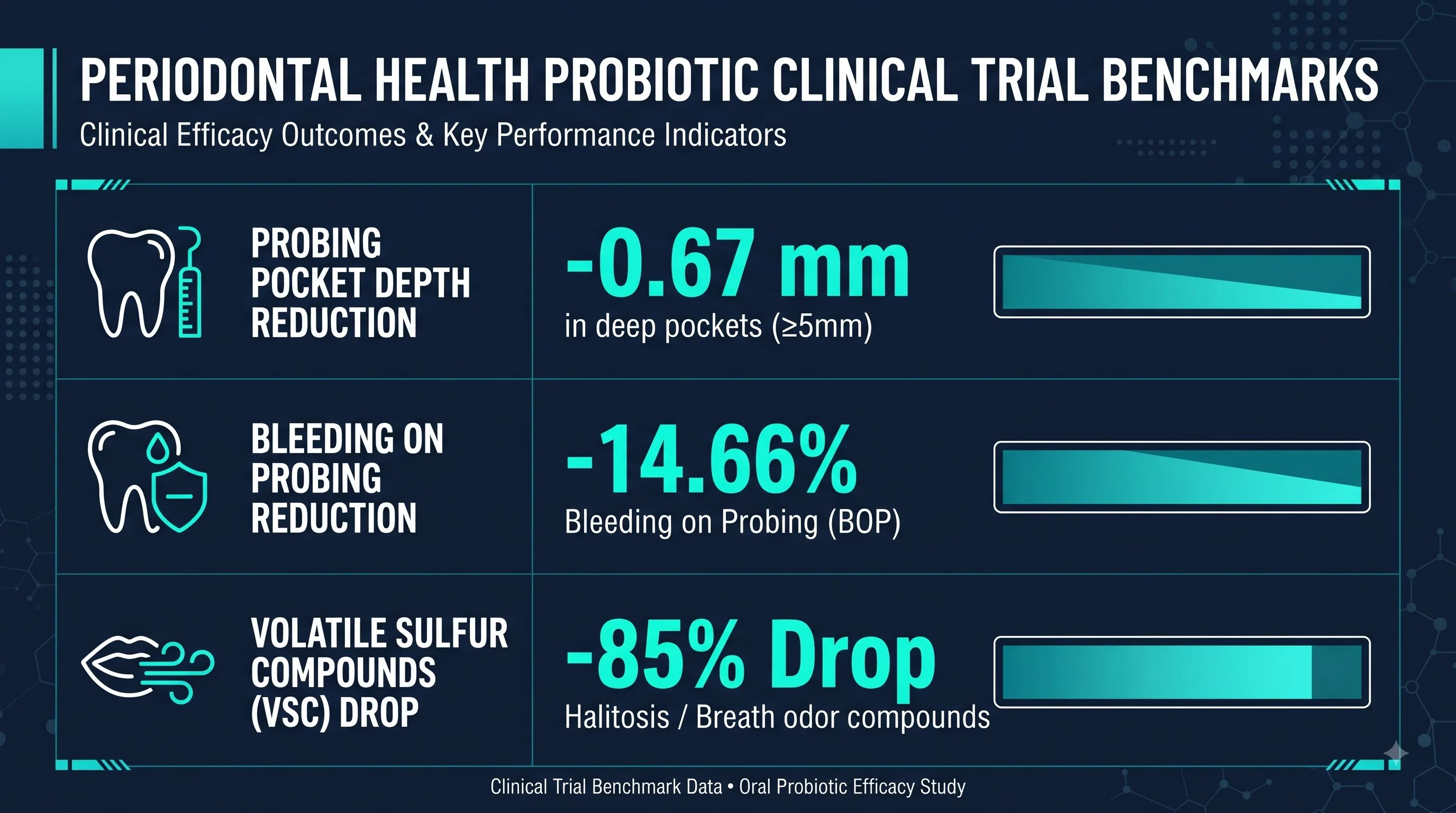
- Deep Pocket Depth Reduction (-0.67 mm): In randomized clinical trials meta-analyzed by Martin-Cabezas et al., adjunctive Lactobacillus reuteri lozenges produced statistically significant additional PPD reductions in deep pockets (≥6 mm, P < .001) and moderate pockets (4–5 mm, -0.18 mm, P = .001). [Martin-Cabezas 2016]
- Bleeding on Probing Reduction (-14.66%): Patients receiving probiotic therapy demonstrated a statistically significant 14.66% greater reduction in bleeding on probing (BOP) compared to mechanical debridement alone (P = .003). [Martin-Cabezas 2016]
- Clinical Attachment Level (CAL) Gains: Overall meta-analysis established a significant short-term clinical attachment gain (-0.42 mm, P = .002) in favor of the probiotic test group. [Martin-Cabezas 2016]
- Halitosis Volatile Sulfur Compound Clearance (85%): In controlled trials, 85% of subjects receiving Streptococcus salivarius K12 lozenges achieved >100 ppb reductions in volatile sulfur compounds on Halimeter testing vs. 30% in placebo controls. [Burton 2006]
- Plaque Biofilm & S. mutans Suppression: Supplementation with Streptococcus salivarius M18 significantly reduced plaque accumulation scores and salivary Streptococcus mutans bacterial counts (P < .05). [Burton 2013]
1. Clinical Practice Guideline Consensus (EFP & ADA)
EFP S3 Clinical Practice Guideline Notice
The European Federation of Periodontology (EFP) S3-level guidelines for the treatment of Stage I–III periodontitis evaluated probiotics alongside other chemical and biological adjuncts. The guideline panel issued a recommendation that probiotics are not suggested as a routine adjunct to subgingival instrumentation. While randomized controlled trials demonstrate significant short-term pocket depth and bleeding improvements for specific strains, scientific consensus requires larger multi-center long-term trials before endorsing universal clinical prescription.
If your dentist just probed your gumline and started calling out alarming numbers like "5 millimeters" or "6 millimeters"—or if you keep seeing pink in the bathroom sink whenever you brush—it is completely normal to feel a spike of dread. You start worrying about receding gums, loose teeth, and expensive, painful periodontal surgery.
Lately, chewable oral probiotics have exploded across social media with flashy ads promising to "cure gum disease overnight." But what happens when you strip away the marketing hype and examine the real clinical trial data?
🌿 The Garden Metaphor: Why Traditional Mouthwashes Often Backfire
Think of your mouth as a living garden. For decades, we were told to treat our mouths like sterile kitchen countertops—scrubbing with aggressive abrasive toothpastes and swishing with stinging, alcohol-based mouthwashes that boast of "killing 99% of germs."
The problem? That scorched-earth approach wipes out the beneficial "guardian" bacteria alongside the bad ones. You leave behind barren, dry oral tissue where aggressive, odor-causing anaerobes quickly sprout right back like stubborn weeds. Oral probiotics take the exact opposite strategy: they plant billions of hardy, beneficial grass seeds that physically crowd out the weeds so they cannot gain a foothold.
2. Periodontal Pocket Depth (PPD) & Attachment Benchmarks
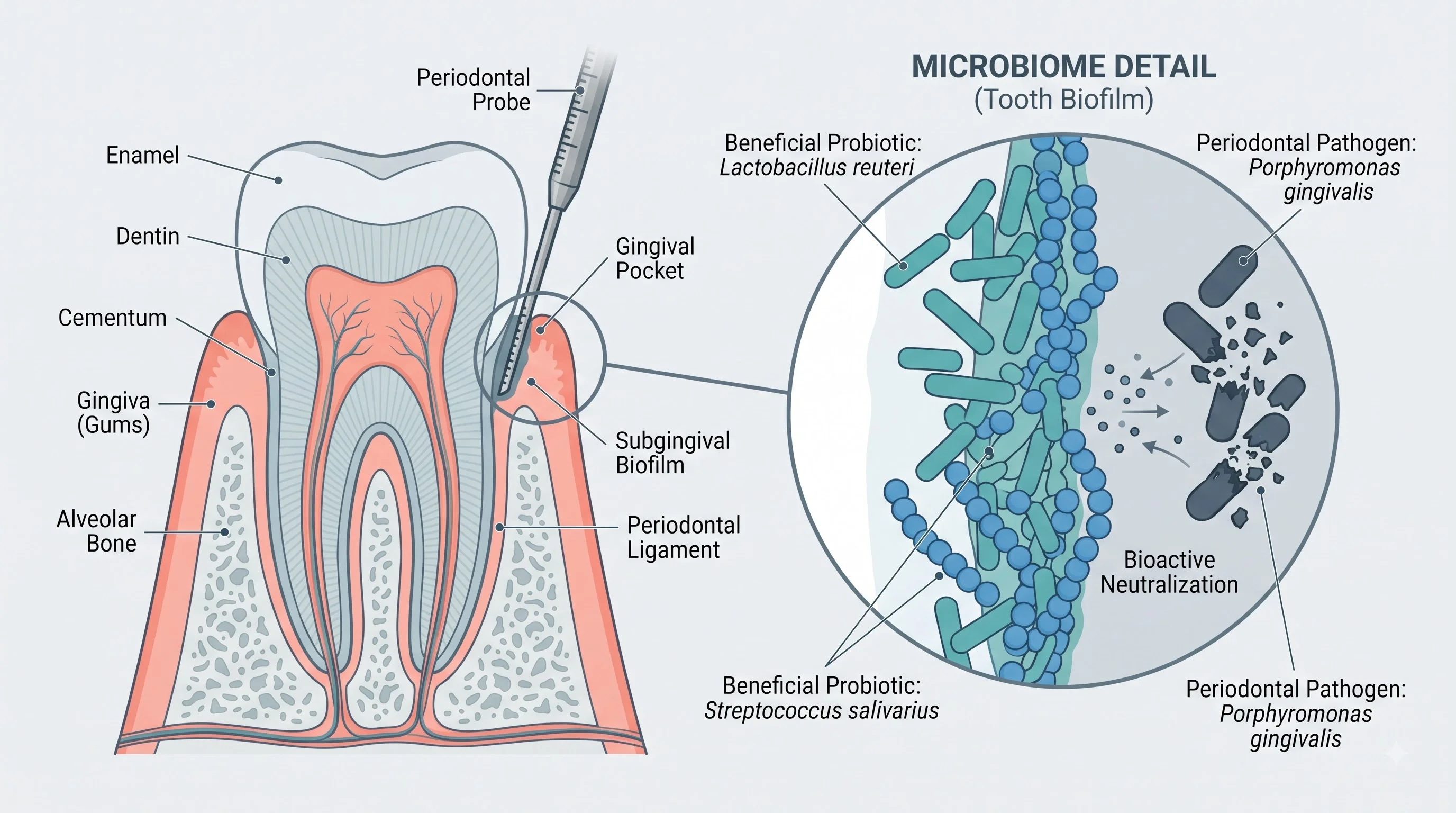
Periodontal pockets are the microscopic gaps that open up between your gums and tooth roots when bacterial plaque triggers chronic inflammation. A healthy gum pocket measures a tight 1 to 3 millimeters. When plaque sits undisturbed, bacteria dig deeper, causing the gum attachment to pull away. Once pockets reach 4 to 7 millimeters, normal toothbrush bristles and dental floss can no longer reach the bottom.
In a landmark meta-analysis published in the Journal of Clinical Periodontology, Dr. Rodrigo Martin-Cabezas and colleagues pooled randomized controlled trials testing Lactobacillus reuteri lozenges alongside professional deep cleanings (scaling and root planing, or SRP). Here is what the numbers actually showed:
📏 In Plain English: What a "-0.67 mm" Pocket Reduction Means For You
In deep, severe pockets (≥6 mm), taking oral probiotics helped shrink the pocket by an extra 0.67 millimeters compared to a deep cleaning alone.
In everyday life, half a millimeter sounds microscopic. But in clinical dentistry, half a millimeter is massive: it is often the exact biological threshold between a pocket that stabilizes and heals versus a pocket that continues losing bone and eventually requires surgical osseous surgery.
| Periodontal Parameter | Probiotic Test Group | Control Arm (SRP Alone) | Net Difference | Statistical Significance |
|---|---|---|---|---|
| Deep Pocket Reduction (≥6 mm) | -2.87 mm | -2.20 mm | -0.67 mm | P < .001 |
| Moderate Pocket Reduction (4–5 mm) | -1.42 mm | -1.24 mm | -0.18 mm | P = .001 |
| Clinical Attachment Level (CAL) Gain | +1.56 mm | +1.14 mm | +0.42 mm | P = .002 |
| Bleeding on Probing (BOP) Reduction | -42.3% | -27.6% | -14.66% | P = .003 |
These findings correlate directly with the landmark randomized controlled trial conducted by Teughels et al. (2013), where chronic periodontitis patients received L. reuteri lozenges twice daily for 12 weeks following SRP. Microbiological analysis confirmed a statistically significant reduction in subgingival Porphyromonas gingivalis levels in the probiotic cohort.
3. Bleeding on Probing (BOP) & Gingival Inflammation Reductions
When bacterial lipopolysaccharides (LPS) from subgingival plaque penetrate the sulcular epithelium, host immune cells release pro-inflammatory mediators including Interleukin-1β (IL-1β), Tumor Necrosis Factor-α (TNF-α), and matrix metalloproteinases (MMP-8). This enzymatic cascade breaks down collagen fibers, manifesting clinically as bleeding on gentle probing.
Lactobacillus reuteri strains produce two potent broad-spectrum antimicrobial peptides: reuterin and reutericyclin. These bacteriocins inhibit the growth of periodontal anaerobes without disrupting beneficial commensal populations, producing quantifiable anti-inflammatory benefits across gingival tissues.
4. Chronic Halitosis & Volatile Sulfur Compounds: The S. salivarius K12 Data
If you brush, scrape your tongue, and chew mint gum, yet still notice that sour, sulfurous morning taste creeping back within an hour, you are dealing with volatile sulfur compounds (VSCs).
Deep within the microscopic grooves on the back of your tongue, hidden anaerobic bacteria feast on proteins from saliva and food particles. As they digest, they release microscopic gasses—principally hydrogen sulfide (which smells like rotten eggs) and methyl mercaptan (which smells like decayed cabbage).
Over-the-counter mouthwashes merely mask these gasses with heavy artificial mint or temporarily nuke your mouth with alcohol. But the moment the alcohol evaporates, your mouth becomes dry—and anaerobic bacteria multiply even faster in a dry mouth.
🔬 The 85% Breakthrough: How Streptococcus salivarius K12 Clears Odor
In a clinical trial published in the Journal of Applied Microbiology by Dr. J.P. Burton and colleagues, researchers tested a specialized oral strain called Streptococcus salivarius K12 on chronic bad breath sufferers.
The result? 85% of patients taking the K12 lozenges achieved a dramatic, measurable drop (>100 parts per billion) in breath sulfur levels on clinical Halimeter testing, compared to just 30% in the placebo group. S. salivarius K12 produces natural biological shields called salivaricins that actively neutralize the bacteria causing sulfur gas, without harming normal tissue.
| Clinical Metric | S. salivarius K12 Group | Placebo Control Arm | Clinical Takeaway |
|---|---|---|---|
| Significant VSC Reduction (>100 ppb) | 85.0% (n = 11/13) | 30.0% (n = 3/10) | Statistically significant odor neutralization |
| Bacteriocin Production | Salivaricin A2 & B | None | Selective targeted inhibition of VSC producers |
| Salivary Bacterial Recolonization | Healthy commensal flora | Anaerobic rebound | Durable competitive exclusion |
For individuals managing persistent oral malodor, cross-reference our clinical guide on oral probiotics for chronic bad breath and tongue coating for specific strain sequencing and hygiene timing.
5. Plaque Biofilm Inhibition: S. salivarius M18 & Enzyme Secretion
Unlike intestinal probiotic strains that operate primarily through metabolic byproducts, oral pioneer species like Streptococcus salivarius M18 possess enzymatic mechanisms specifically adapted for the oral cavity:
- Dextranase: An enzyme that hydrolyzes dextran, the insoluble polysaccharide glucan matrix that cariogenic bacteria use to cement themselves into dental plaque biofilm.
- Urease: An enzyme that breaks down salivary urea into ammonia, elevating local plaque pH and neutralizing acidic conditions that cause enamel demineralization.
In a randomized double-blind placebo-controlled trial published by Burton et al. (PMID: 23449874), supplementation with S. salivarius M18 over 3 months produced statistically significant reductions in Modified Quigley-Hein Plaque Index scores and reduced salivary Streptococcus mutans counts. A 2024 randomized trial (PMID: 39057009) confirmed that 3 months of M18 lozenges significantly decreased both gingival bleeding and dental plaque accumulation.
6. Lozenges vs. Capsules: Delivery Mechanisms & Formulation Review
One of the most common—and expensive—mistakes consumers make is buying standard gut probiotic capsules from the grocery store and swallowing them with water, expecting them to heal their gums.
Swallowed capsules do absolutely nothing for your mouth. They are encased in thick gelatin or acid-resistant vegetable shells specifically engineered to survive stomach acid and release their contents deep inside your intestines. The beneficial bacteria never touch your teeth, your tongue, or your bleeding gums.
For oral bacteria to work, they require direct physical residency time in your mouth. They must stick to the moist lining of your cheeks, dissolve into your saliva, and coat the crevices between your teeth and gumlines. This is why clinical trials exclusively use chewable tablets or slow-dissolving lozenges.
🍬 Why Chewable Lozenge Formats Matter: The ProDentim Example
Specialized oral lozenges—such as reviewed in our independent analysis of ProDentim candy ingredients—are formulated as dissolvable soft chews. As the tablet melts in your mouth over several minutes, it floods your saliva with 3.5 billion live cultures of Lactobacillus reuteri and Bifidobacterium lactis, giving them ample time to adhere to the gumline before swallowing.
Explore our full directory of evidence-based oral and dental wellness guides to examine how botanical remineralizing agents and natural antimicrobials integrate with daily hygiene regimens.
7. Interactive Oral Microbiome Clinical Profile Assessment
Select your primary gum and oral symptom profile below to view the corresponding clinical trial evidence, strain recommendations, and safety precautions:
⚠️ Urgent Periodontal Red-Flag Alert
Seek immediate professional dental or periodontal evaluation if you experience: Severe tooth mobility (loose teeth), acute periodontal abscess (painful localized gum swelling with pus or fever), or rapid unexplained gingival recession. These conditions indicate advanced periodontal bone destruction or acute infection requiring immediate surgical debridement or antibiotics. Probiotics are never a substitute for emergency dental intervention.
8. Safety Profile & Adverse Event Analysis
Because the investigated bacterial strains (such as L. reuteri and S. salivarius) are natural commensals isolated from healthy human oral cavities and breast milk, they carry Generally Recognized as Safe (GRAS) status from the US FDA.
| Investigated Strain | Reported Adverse Reactions | Trial Incidence Rate | Clinical Contraindications |
|---|---|---|---|
| Lactobacillus reuteri (DSM 17938 / ATCC PTA 5289) | Mild transient gastrointestinal bloating (rare) | < 2.0% | Severe immunocompromise, central venous catheterization |
| Streptococcus salivarius (K12 / M18) | Mild alteration in mouth taste perception | < 3.5% | Severe neutropenia, advanced immunosuppressive therapy |
| Bifidobacterium lactis | Zero documented oral side effects | < 1.0% | Critical illness / intensive care hospitalization |
9. Frequently Asked Questions (Clinical FAQ)
Can oral probiotics reverse periodontal bone loss?
Can probiotics replace scaling and root planing (deep dental cleanings)?
Which specific probiotic strains have the strongest evidence for gum disease?
Why do chewable lozenges outperform swallowed capsules for dental health?
10. Primary Peer-Reviewed Sources & References
- Martin-Cabezas, R., Davideau, J. L., Tenenbaum, H., & Huck, O. (2016). "Clinical efficacy of probiotics as an adjunctive therapy to non-surgical periodontal treatment of chronic periodontitis: a systematic review and meta-analysis." Journal of Clinical Periodontology, 43(6), 520–530. doi:10.1111/jcpe.12545. PMID: 26970230.
- Teughels, W., Durukan, A., Ozcelik, O., Pauwels, M., Quirynen, M., & Haytac, M. C. (2013). "Clinical and microbiological effects of Lactobacillus reuteri probiotics in the treatment of chronic periodontitis: a randomized placebo-controlled study." Journal of Clinical Periodontology, 40(11), 1025–1035. doi:10.1111/jcpe.12155. PMID: 24164569.
- Burton, J. P., Chilcott, C. N., Moore, C. J., Speiser, G., & Tagg, J. R. (2006). "A preliminary study of the effect of probiotic Streptococcus salivarius K12 on oral malodour parameters." Journal of Applied Microbiology, 100(4), 754–764. doi:10.1111/j.1365-2672.2006.02837.x. PMID: 16553730.
- Burton, J. P., Drummond, B. K., Chilcott, C. N., et al. (2013). "Influence of the probiotic Streptococcus salivarius strain M18 on indices of dental health in children: a randomized double-blind, placebo-controlled trial." Journal of Medical Microbiology, 62(Pt 6), 875–884. doi:10.1099/jmm.0.056663-0. PMID: 23449874.
- Sanz, M., Herrera, D., Kebschull, M., et al. (2020). "Treatment of stage I–III periodontitis—The EFP S3 level clinical practice guideline." Journal of Clinical Periodontology, 47(Suppl 22), 4–60. doi:10.1111/jcpe.13290. [European Federation of Periodontology Practice Guidelines].