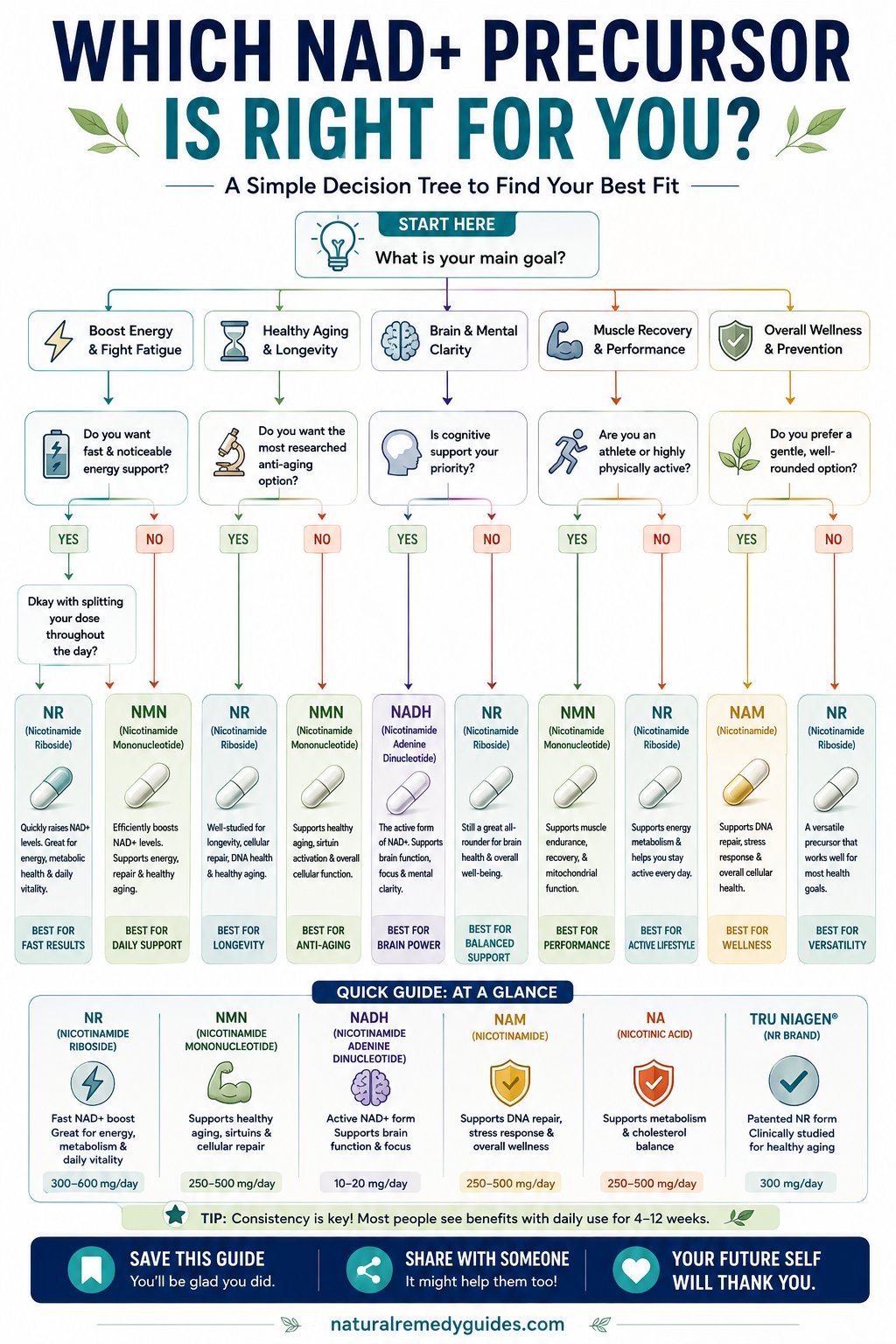
What it is: An NAD precursor supplement delivers targeted cellular building blocks—chiefly NMN (Nicotinamide Mononucleotide) and NR (Nicotinamide Riboside)—that your body converts into NAD+, the master coenzyme responsible for cellular energy production, DNA repair, and vitality.
Does it work: Yes. Human clinical trials show that daily precursor supplementation increases circulating NAD+ levels by 40% to 150%, supporting physical endurance, cognitive focus, and cellular recovery.
The evidence: Published human trials in Nature Communications and Science demonstrate that precursors safely replenish age-depleted NAD+ pools. Combining precursors with mitochondrial cofactors like CoQ10 and PQQ enhances overall cellular efficiency.
Verdict: Avoid wasting money on direct NAD+ capsules that degrade in stomach acid. Choose an advanced precursor formula (such as Advanced Mitochondrial Formula) that pairs bioavailable precursors with vital mitochondrial spark plugs for sustained daily stamina.
Choosing an NAD precursor supplement is one of the most effective ways to combat the unexplained fatigue and sluggish recovery that creep in after age 40. By the time you reach middle age, your body’s natural supply of NAD+ has plummeted by nearly half—leaving your cellular engines running on empty even when you eat well and get a full night of rest.
Recharge Your Cellular Energy from the Inside Out
Discover Advanced Mitochondrial Formula →Doctor-formulated cellular nutrition • 90-day money-back guarantee
Why You Need an NAD Precursor Supplement Instead of Pure NAD+
Do you remember being in your twenties, when you could tackle an intense workout, work a long day, and wake up the next morning feeling energized and ready to go? Fast forward a couple of decades, and the story changes. You wake up feeling foggy, that 3 PM slump hits harder than ever, and minor workouts leave your muscles sore for days.
This decline is not just "getting older"—it is driven by a measurable biochemical deficit. Inside almost every cell in your body are microscopic engines called mitochondria. They convert the food you eat and the air you breathe into cellular energy (ATP). But mitochondria cannot generate ATP without a master helper molecule called NAD+ (Nicotinamide Adenine Dinucleotide).
Think of NAD+ as your cell's rechargeable battery pack. Every time your cell generates energy, repairs damaged DNA, or combats inflammation, it drains that battery. Unfortunately, between the ages of 20 and 50, your body's ability to produce NAD+ drops by up to 50%. Your cellular power plants are literally starved of fuel.
The natural reaction is to ask: "Why can't I just take an NAD+ pill?"
The problem is biological size. A complete NAD+ molecule is large and chemically delicate. When swallowed, harsh stomach acid and digestive enzymes instantly chop it up into smaller fragments before it can ever cross your gut lining. Taking pure oral NAD+ is like trying to mail a full-sized living room sofa through a tiny door letterbox—it simply cannot get through intact.
This is where an NAD precursor supplement solves the puzzle. Instead of swallowing the bulky final molecule, you provide your body with compact, stable building blocks—like NMN or NR. Your cells absorb these precursors effortlessly through specialized transporters and assemble fresh, active NAD+ right where it is needed.
Comparing Popular NAD+ Precursor Forms
| Precursor Form | How Your Body Uses It | Key Research Highlights | Practical Takeaway |
|---|---|---|---|
| NMN (Nicotinamide Mononucleotide) | One direct enzymatic step away from NAD+ | Clinical trials show rapid cellular absorption via Slc12a8 transporters and improved muscle insulin sensitivity (PMID: 33888596) | Excellent direct precursor for fast cellular uptake and muscular recovery |
| NR (Nicotinamide Riboside) | Two-step enzymatic conversion pathway | Extensive human safety trials demonstrate 40% to 60% increases in circulating blood NAD+ levels (PMID: 29599478) | Reliable, heavily studied precursor with proven oral bioavailability |
| Direct Oral NAD+ | Swallowing whole NAD+ molecules | Degrades rapidly in gastric acid; fails to reach target cellular tissues intact | Not Recommended: Low oral bioavailability results in poor cellular results |
| Comprehensive Mitochondrial Complex | Precursors combined with CoQ10, PQQ, and Resveratrol | Combines the NAD+ fuel molecule with the electron-transport spark plugs your cellular engines need to fire | Gold Standard: Delivers all-day sustained energy without caffeine spikes or crashes |
Why Companion Nutrients Make Your NAD Precursor Supplement Work Better
While raising your cellular NAD+ supply is crucial, fuel alone isn't enough to make an engine run smoothly. If you pump high-octane gasoline into a sports car that has dirty spark plugs and an overheating radiator, the car will still sputter.
Your mitochondria function the exact same way:
- NAD+ is the High-Octane Fuel: It feeds the Krebs cycle and activates longevity enzymes called sirtuins.
- CoQ10 is the Spark Plug: Coenzyme Q10 shuttles electrons across the inner mitochondrial membrane, converting raw nutrients into usable ATP energy.
- PQQ Triggers New Engine Growth: Pyrroloquinoline Quinone (PQQ) has been shown to stimulate mitochondrial biogenesis—prompting your cells to grow fresh, youthful power plants.
- Resveratrol Protects the System: This potent grape polyphenol works synergistically with NAD+ to activate SIRT1 repair pathways, protecting cells against daily oxidative stress.
NAD Precursor Supplements: Honest Pros & Cons
What We Like
- Replenishes the master cellular coenzyme responsible for youthful vitality and clear thinking
- Backed by peer-reviewed human clinical trials in top journals like Nature and Science
- Delivers clean, steady all-day stamina without the jitters, palpitations, or crashes of caffeine
- Supports natural DNA repair mechanisms and cellular resilience against aging
What to Keep in Mind
- Higher cost than ordinary drugstore multivitamins due to specialized enzymatic synthesis
- Requires daily consistency over 4 to 8 weeks for cellular energy pools to fully recharge
- Purity matters greatly — avoid low-grade bulk powders with unknown third-party testing
What to Expect: The 6-Week Cellular Energy Timeline
When you begin taking a doctor-formulated NAD precursor supplement, your cellular recharge happens in distinct stages:
- Weeks 1 to 2 (Mental Clarity & Morning Wakefulness): As circulating NAD+ levels rise, many users report feeling clearer-headed upon waking, with a noticeable reduction in mid-afternoon brain fog.
- Weeks 3 to 4 (Physical Stamina & Bounce-Back): With mitochondrial respiration ramping up, everyday activities feel less taxing. You recover faster from yard work or workouts without lingering stiffness.
- Weeks 5 and Beyond (Deep Cellular Vitality): As cellular repair pathways remain active, sustained daytime energy becomes your new baseline, supporting long-term metabolic and cognitive health.
Frequently Asked Questions About NAD Precursors
Why can't you just swallow a pure NAD+ pill?
Pure NAD+ is a large, fragile molecule that is rapidly destroyed by digestive enzymes in your stomach before it can enter your bloodstream. Precursors like NMN and NR are smaller, stable building blocks that cells easily absorb and assemble into fresh NAD+ internally.
What is the key difference between NMN and NR (Nicotinamide Riboside)?
Both compounds safely boost NAD+ in human clinical trials. NMN is one direct step away from NAD+, while NR takes two chemical steps. In clinical studies, both show rapid absorption, with NMN showing particularly strong cellular uptake kinetics.
Why should an NAD precursor supplement be paired with CoQ10 and PQQ?
Think of NAD+ as the fuel for your cellular engines (mitochondria), while CoQ10 and PQQ act as the spark plugs. Providing both the fuel and the ignition cofactors ensures your cells generate steady, natural energy without jitters or crashes (see our comprehensive 2026 guide on the best mitochondrial supplements to see how multi-pathway synergy works).
Experience Youthful Cellular Energy Again
Try Advanced Mitochondrial Formula Risk-Free →Comprehensive mitochondrial vitality formula • 90-day money-back guarantee
Clinical References & Longevity Research
- Nature Communications: Martens CR, et al. Chronic nicotinamide riboside supplementation is well-tolerated and elevates NAD(+) in healthy middle-aged and older adults (PMID: 29599478).
- Science: Yoshino M, et al. Nicotinamide mononucleotide increases muscle insulin sensitivity in clinical trials (PMID: 33888596).
- Endocrine Journal: Irie J, et al. Effect of oral administration of nicotinamide mononucleotide on clinical parameters and metabolic markers in healthy human participants (PMID: 31685720).
FDA Disclaimer: These statements have not been evaluated by the Food and Drug Administration. This product is not intended to diagnose, treat, cure, or prevent any disease.
Independent Wellness Research & Editorial Standards
Our Wellness Research Approach: We explore publicly available scientific literature, nutritional research, botanical studies, and traditional wellness practices to help readers understand natural supplements and healthy lifestyle habits. Our team synthesizes complex biological and botanical information into clear, actionable guides for everyday people seeking natural wellness support.
Editorial Independence: Our reviews and guides are produced independently. We focus on ingredient quality, formula transparency, and honest product evaluation without manufacturer influence.
Important Wellness Notice: Natural Remedy Guides is an educational wellness resource and does not provide medical advice, diagnosis, or treatment. Dietary supplements are not intended to diagnose, treat, cure, or prevent any medical condition. Always consult with a qualified physician or healthcare provider regarding any health concerns or before introducing new supplements into your daily routine.