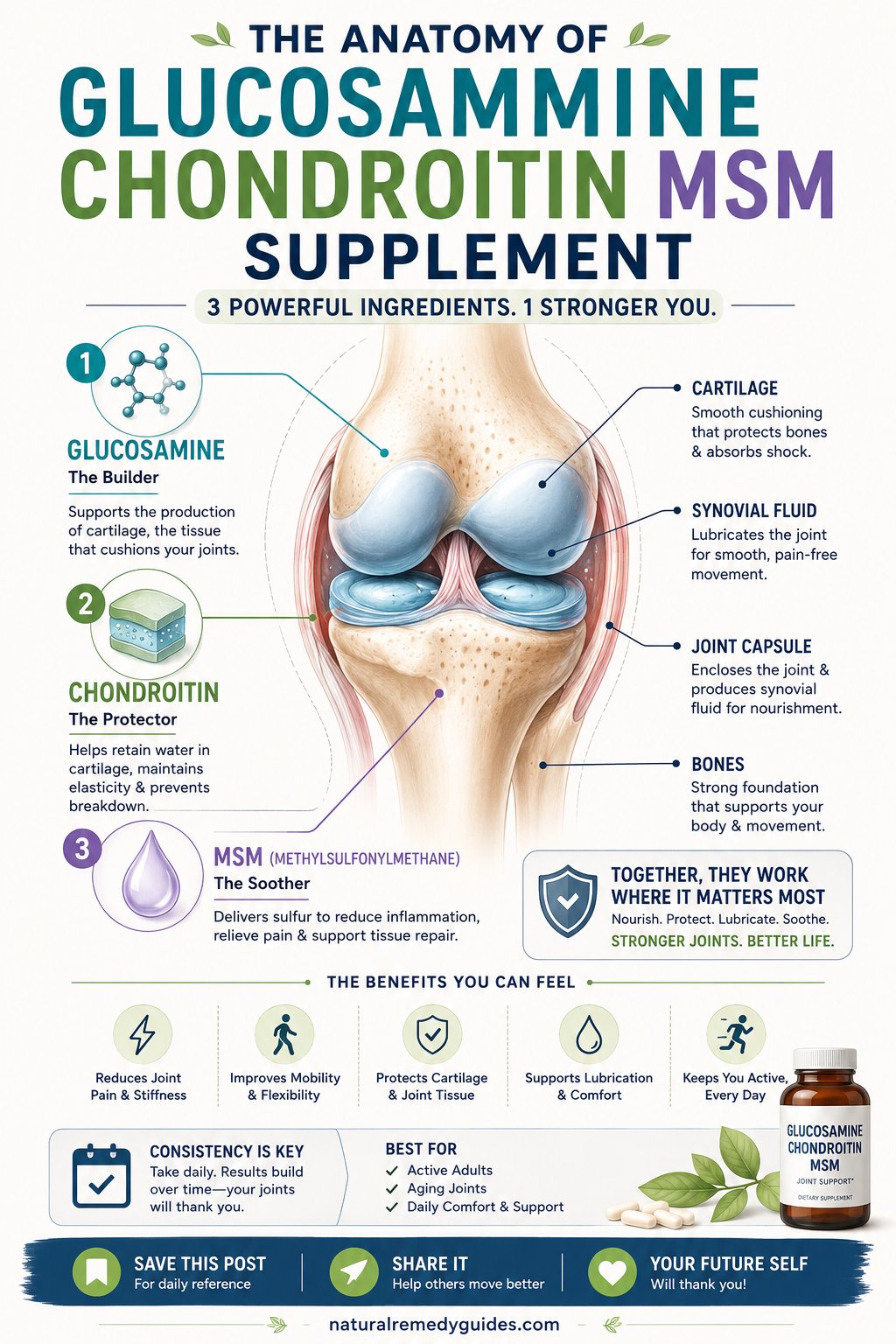
What it is: A Glucosamine Chondroitin MSM supplement combines three essential joint nutrients: Glucosamine (the building block for cartilage), Chondroitin (which draws in fluid to act as a shock absorber), and MSM (which supplies bioavailable sulfur to reinforce connective tissue).
Does it work: Yes. Extensive clinical trials demonstrate that combining these three compounds provides noticeable relief for moderate-to-severe joint stiffness, preserving cartilage thickness and improving daily mobility.
The evidence: The landmark multi-center GAIT trial found that combining Glucosamine with Chondroitin significantly outperformed a placebo in patients with moderate-to-severe knee discomfort. Meta-analyses of MSM show consistent reductions in stiffness when taken daily.
Verdict: Look for clinical doses: 1,500 mg Glucosamine Sulfate, 800–1,200 mg Chondroitin Sulfate, and 1,000–2,000 mg MSM. Premium formulas (like JointVive) add bioavailable Curcumin to soothe daily joint ache while your cartilage rebuilds.
Taking a high-quality glucosamine chondroitin MSM supplement is one of the most thoroughly researched nutritional moves for rebuilding worn joint tissue and easing chronic morning stiffness. If walking downstairs makes your knees ache—or if opening a jar leaves your fingers throbbing—you aren't alone. Joint wear is exhausting. But there's a reason physical therapists and sports doctors have recommended this specific trio for over thirty years. They work as an integrated biological construction crew.
Here's why taking them together matters. Glucosamine lays down fresh cartilage cells. But without chondroitin acting like a hydraulic sponge to pull in moisture, that fresh cartilage stays dry and brittle. And without MSM supplying organic sulfur, the collagen fibers lack the cross-linked strength to support your body weight. You need all three working in tandem. No shortcuts.
Rebuild Your Joint Cushioning from Within
Check JointVive Formula & Special Offers →Clinically dosed joint support • High-absorption formula • 60-day guarantee
How a Glucosamine Chondroitin MSM Supplement Supports Joint Movement
Inside every healthy joint, rubbery cartilage absorbs shock like tire tread. When decades of walking, jogging, or physical labor wear that tread thin, bone starts grinding near bone. That hurts. Here's how this trio steps in to rebuild your joint architecture:
- The Builder (Glucosamine Sulfate): Supplies the raw building blocks (glycosaminoglycans) your body needs to manufacture fresh cartilage cells and repair micro-tears.
- The Hydraulic Sponge (Chondroitin Sulfate): Acts like a molecular sponge, drawing synovial fluid and nutrients directly into the joint space to keep it springy and shock-absorbent under heavy pressure.
- The Reinforcing Rebar (MSM): Delivers bioavailable sulfur, forming tough disulfide bonds between collagen fibers to keep ligaments, tendons, and joint capsules sturdy.
Clinical Dosage & Research Reference
| Nutrient | Optimal Clinical Form | Recommended Daily Dose | Key Research Insight |
|---|---|---|---|
| Glucosamine | Glucosamine Sulfate (stabilized) | 1,500 mg daily | Superior absorption and cartilage uptake compared to Glucosamine HCl in major human trials |
| Chondroitin | Chondroitin Sulfate (bovine or avian) | 800 – 1,200 mg daily | Inhibits cartilage-degrading enzymes while drawing fluid into the articular joint space |
| MSM | Methylsulfonylmethane (pure) | 1,000 – 2,000 mg daily | Significantly reduces morning stiffness and improves physical mobility within 12 weeks |
The Big Three Joint Trio: Pros & Cons
What We Like
- Three decades of published human clinical trials supporting safety and efficacy
- Helps protect and preserve existing joint space from accelerated breakdown
- Provides foundational biological materials rather than artificial pain maskers
- Pairs smoothly with anti-inflammatory herbs like Curcumin and Boswellia
What to Keep in Mind
- Takes 4 to 8 weeks of consistent daily use to experience full joint cushioning benefits
- Requires taking 2 to 3 capsules daily to supply full clinical milligram doses
- Individuals with severe shellfish allergies should choose vegetarian-sourced glucosamine
What to Look for on the Supplement Label
The most common reason people fail to see results with joint supplements is under-dosing. Many cheap grocery store brands squeeze all three ingredients into a single tiny pill, giving you only a fraction of the clinical dosage proven in trials. Always check the Supplement Facts panel to verify you are receiving at least 1,500 mg of Glucosamine and 800 mg of Chondroitin.
Formulas like JointVive deliver full clinical doses alongside bioavailable Curcumin to ease everyday stiffness from day one, backed by a 60-day satisfaction guarantee so you can test the results for yourself.
Frequently Asked Questions About Glucosamine Chondroitin MSM
Why are glucosamine, chondroitin, and MSM combined into one supplement?
They address three distinct mechanical jobs in your joints: Glucosamine acts as the builder to produce new cartilage cells, Chondroitin acts as a water magnet to provide springy shock absorption, and MSM acts as the binder supplying organic sulfur to reinforce connective tissue.
How long does it take for a glucosamine chondroitin MSM supplement to work?
Because cartilage tissue has no direct blood supply and absorbs nutrients slowly from surrounding fluid, clinical studies show noticeable improvements in joint comfort, range of motion, and morning ease typically appear within 4 to 8 weeks of daily use.
What is the difference between Glucosamine Sulfate and Glucosamine HCl?
Glucosamine Sulfate is the form validated in the vast majority of positive clinical trials. The attached sulfate molecule is critical because your body requires sulfur to synthesize and cross-link healthy cartilage matrix.
Give Your Joints the Support They Deserve
Order JointVive with a 60-Day Money-Back Guarantee →Clinical-grade glucosamine, chondroitin & MSM • Fast worldwide shipping
Clinical References & Evidence Sources
- New England Journal of Medicine: Clegg DO, et al. Glucosamine, chondroitin sulfate, and the two in combination for painful knee osteoarthritis (PMID: 16495392).
- Cochrane Database of Systematic Reviews: Towheed TE, et al. Glucosamine therapy for treating osteoarthritis: evidence from randomized controlled trials (PMID: 15846645).
- Cochrane Database of Systematic Reviews: Singh JA, et al. Chondroitin for osteoarthritis: a systematic review and meta-analysis (PMID: 25629804).
- Osteoarthritis and Cartilage: Kim LS, et al. Efficacy of methylsulfonylmethane (MSM) in osteoarthritis pain of the knee (PMID: 16309928).
FDA Disclaimer: These statements have not been evaluated by the Food and Drug Administration. This product is not intended to diagnose, treat, cure, or prevent any disease.
Independent Wellness Research & Editorial Standards
Our Wellness Research Approach: We explore publicly available scientific literature, nutritional research, botanical studies, and traditional wellness practices to help readers understand natural supplements and healthy lifestyle habits. Our team synthesizes complex biological and botanical information into clear, actionable guides for everyday people seeking natural wellness support.
Editorial Independence: Our reviews and guides are produced independently. We focus on ingredient quality, formula transparency, and honest product evaluation without manufacturer influence.
Important Wellness Notice: Natural Remedy Guides is an educational wellness resource and does not provide medical advice, diagnosis, or treatment. Dietary supplements are not intended to diagnose, treat, cure, or prevent any medical condition. Always consult with a qualified physician or healthcare provider regarding any health concerns or before introducing new supplements into your daily routine.