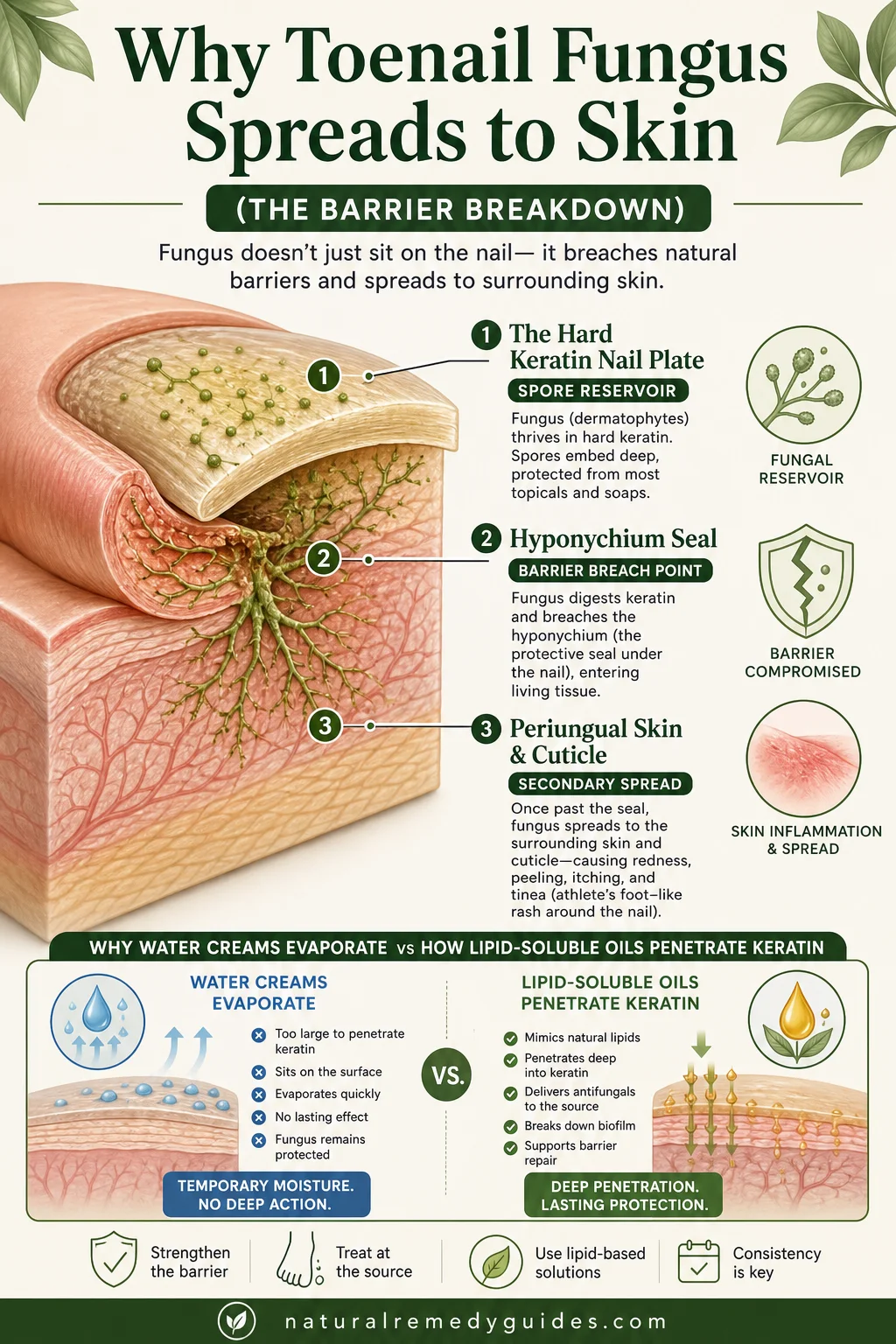
What it is: Fungal migration occurs when an established onychomycosis infection in the toenail plate breaches the anatomical hyponychium barrier, allowing active dermatophyte spores to colonize the periungual skin, cuticle, and interdigital toe webs.
Does it work: Yes, applying lipid-soluble botanical oils with proven antifungal fatty acids (such as Undecylenic Acid, Tea Tree, and Lavender) penetrates dense keratin layers that water-based creams cannot reach, arresting cross-tissue spore shedding.
The evidence: Clinical mycological studies demonstrate that dermatophyte fungi (*Trichophyton rubrum*) produce proteolytic keratolytic enzymes that dissolve the periungual skin seal. Fatty acid derivatives like undecylenic acid and essential oil terpenes exhibit potent fungistatic action against biofilm-protected spores.
Verdict: Kerassentials delivers a clinical blend of high-grade undecylenic acid and organic botanical oils formulated specifically to penetrate stubborn nail keratin and soothe infected surrounding skin. Backed by a 60-day 100% money-back guarantee, it halts the cycle of spore migration.
Discovering that your toenail fungus is spreading to the surrounding skin is a deeply alarming moment. What began as a localized yellow streak or brittle corner on a single toenail has suddenly crossed the border: the skin along your cuticle is inflamed, the side of your toe is peeling and raw, and the spaces between your toes itch relentlessly. When an infection begins expanding, frustration and anxiety quickly follow.
Most individuals assume that a fungal nail infection stays locked within the hard shell of the nail plate. But human anatomy is interconnected. Your toenail does not sit on an isolated island—it is anchored into living vascular tissue, surrounded by delicate skin folds that share the exact same microclimate. When you understand the biological failure of the nail's physical barrier, the reason behind this rapid spread becomes crystal clear.
Fungal organisms do not spread because you are unhygienic; they spread because they possess specialized enzymes engineered to break down biological barriers, while traditional drugstore creams fail to penetrate the fungal reservoir.
Penetrate Dense Nail Keratin & Halt Fungal Spore Migration
Check Kerassentials Official Pricing & Packages →Backed by a 60-day 100% money-back guarantee • Premium cGMP-certified lipid formula • Free US shipping on multi-bottle packs
The Anatomy of Fungal Migration: How the Hyponychium Seal Fails
To understand why toenail fungus spreads to skin, we must examine the microscopic border patrol of the human toe. Beneath the free edge of your toenail lies a specialized epithelial layer known as the hyponychium. Together with the lateral nail folds and the proximal cuticle (eponychium), the hyponychium forms a waterproof, airtight seal that prevents external pathogens from invading the subungual nail bed.
In a healthy toe, this seal is virtually impenetrable. However, chronic nail fungus—most commonly caused by the filamentous dermatophyte Trichophyton rubrum—operates like a slow-moving siege engine. Dermatophytes thrive on keratin, the fibrous structural protein that forms both your nails and the outermost layer of your skin (the stratum corneum). Here is the 3-stage chain reaction that allows fungus to breach the skin barrier:
- Keratolytic Enzyme Digestion: Dermatophyte fungi secrete specialized protease and keratinase enzymes that actively dissolve keratin bonds. Over months of unchecked proliferation, these enzymes chew through the dense subungual tissue, degrading the structural integrity of the hyponychium seal.
- Subungual Biofilm Formation: As the fungal colony matures under the nail plate, it weaves a protective extracellular polysaccharide matrix (biofilm). This microscopic slime shield glues thousands of fungal spores together, shielding them from the body's immune response and creating an overcrowded fungal pressure cooker.
- Spore Overflow & Skin Colonization: With the hyponychium seal compromised and subungual space fully colonized, micro-spores spill outward along the path of least resistance. They land directly on the warm, moist periungual skin surrounding the toe, immediately initiating secondary tinea pedis (athlete's foot).
The Big Fallacy: Why Standard Over-the-Counter Creams Fail
When people notice the fungal infection creeping onto their toe skin, their immediate instinct is to purchase an over-the-counter antifungal cream (such as clotrimazole, miconazole, or terbinafine lotions) and slather it over the toe. Yet within weeks, the skin rash returns or worsens.
Why do these popular products fail so consistently? The answer lies in biophysics: **water cannot penetrate oil, and creams cannot penetrate dense keratin**.
Human toenails are remarkably dense structures—averaging between 0.5 to 1.0 millimeter in thickness—composed of tightly packed, hydrophobic (water-repelling) dead keratinocytes. Standard over-the-counter creams are water-in-oil or oil-in-water emulsions designed for superficial cutaneous application. When applied to a fungal toe:
- The water content in the lotion rapidly evaporates within minutes of application.
- The active drug molecules remain trapped on the dry surface of the nail plate, unable to cross the dense keratin matrix.
- The deep reservoir of fungal spores living deep inside the subungual bed remains 100% untouched.
While the topical cream may temporarily kill off surface fungal spores on the skin, the untreated colony beneath the nail continuously "re-seeds" the adjacent skin 24 hours a day. It is like mowing weeds while leaving the underground roots entirely intact.
Clinical Evidence: The Power of Lipid-Soluble Antifungal Oils
To permanently stop toenail fungus from spreading to surrounding skin, you must attack the problem with compounds capable of penetrating the microscopic channels of the nail plate while simultaneously soothing irritated skin tissue.
Peer-reviewed mycological research highlights several key botanical compounds that possess the exact molecular weight and lipophilic properties necessary for deep tissue delivery:
- Undecylenic Acid (FDA-Recognized Fatty Acid): An unsaturated fatty acid derived from natural castor oil, undecylenic acid is clinically documented to inhibit the morphogenetic transformation of fungal cells into invasive hyphae. Studies confirm it disrupts fungal cell membrane permeability without irritating delicate cuticles.
- Standardized Tea Tree Oil (*Melaleuca alternifolia*): Rich in terpinen-4-ol, pharmaceutical-grade tea tree oil demonstrates broad-spectrum fungistatic activity against *Trichophyton rubrum* and *Candida albicans*, helping break down stubborn subungual biofilms.
- High-Oleic Organic Flaxseed Oil & Sweet Almond Oil: These rich carrier lipids serve as deep penetration enhancers, carrying active botanical antifungals beneath the lateral nail folds while restoring the compromised lipid barrier of the surrounding skin.
- Lavender & Aloe Vera Extracts: Provide potent anti-inflammatory relief to eliminate the redness, burning, and skin peeling caused by secondary fungal migration.
Stop the Fungal Cycle: Protect Your Nails & Skin with Kerassentials
Order Kerassentials Directly from the Official Lab →Includes 4 brush-on applicators per bottle • Doctor-formulated natural oil blend • 100% money-back guarantee for 60 days
Practical 4-Step Daily Protocol to Arrest Fungal Spread
If your toenail fungus has already begun spreading to your skin, following a disciplined, multi-layered daily routine is vital to starve the fungal colony of moisture while restoring the biological seal of your nail folds:
- Dry Thoroughly Before Application: Fungi thrive in moisture. After showering, dry your toes thoroughly with a clean paper towel (never re-use cloth towels, which cross-contaminate other toes). Allow 5 minutes of air drying.
- Apply a Deep-Penetrating Lipid Oil: Using a precision applicator, brush a high-potency antifungal oil blend like Kerassentials directly across the nail surface, under the free edge of the hyponychium, and into the surrounding cuticle grooves.
- Wear Breathable, Moisture-Wicking Socks: Discard synthetic nylon socks that trap perspiration. Switch to 100% merino wool or bamboo fibers that pull moisture away from vulnerable skin.
- Disinfect Footwear Daily: Fungal spores shed from infected skin survive for months inside dark shoe linings. Spray shoes daily with an antifungal botanical mist or use a UV shoe sanitizer to prevent constant re-infection.
The Bottom Line: Reclaiming Clear Nails & Healthy Skin
When toenail fungus spreads to your skin, it is a clear warning that your nail's physical defenses have been compromised and surface-level drugstore creams are not doing the job. You cannot solve a deep subungual infection with water-based lotions that sit on the surface.
By switching to targeted, lipid-soluble botanicals that penetrate the dense keratin plate, you cut off the fungal reservoir at its root and protect your delicate skin from recurring outbreaks. Kerassentials provides the ideal synergy of undecylenic acid and restorative plant oils to help you restore clear, strong nails and calm, irritation-free skin.
Ready for Clear Nails & Healthy Skin? Try Kerassentials Today
Claim Your Kerassentials Discount Package Here →Ships direct from FDA-registered, cGMP-certified USA facility • Protected by a full 60-day money-back guarantee
Scientific References & Clinical Literature
- Elewski BE. Onychomycosis: Pathogenesis, diagnosis, and management. Clin Microbiol Rev. 1998;11(3):415-429. PMID: 9665975
- Chretien JH, Esswein JG, Sharpe LM. Efficacy of undecylenic acid-zinc undecylenate in the treatment of tinea pedis and dermatophyte infections. Int J Dermatol. 1980;19(1):51-54. PMID: 7353982
- Syed TA, Qureshi ZA, Ali SM, et al. Treatment of toenail onychomycosis with 2% butenafine and 5% Melaleuca alternifolia (tea tree) oil in cream. Trop Med Int Health. 1999;4(4):284-287. PMID: 10328906
- Burkhart CN, Burkhart CG, Gupta AK. Dermatophyte biofilm formation in subungual space: Mechanisms of therapeutic recalcitrance. J Am Acad Dermatol. 2002;47(4):629-631. PMID: 12271313
Independent Wellness Research & Editorial Standards
Our Wellness Research Approach: We explore publicly available scientific literature, nutritional research, botanical studies, and traditional wellness practices to help readers understand natural supplements and healthy lifestyle habits. Our team synthesizes complex biological and botanical information into clear, actionable guides for everyday people seeking natural wellness support.
Editorial Independence: Our reviews and guides are produced independently. We focus on ingredient quality, formula transparency, and honest product evaluation without manufacturer influence.
Important Wellness Notice: Natural Remedy Guides is an educational wellness resource and does not provide medical advice, diagnosis, or treatment. Dietary supplements are not intended to diagnose, treat, cure, or prevent any medical condition. Always consult with a qualified physician or healthcare provider regarding any health concerns or before introducing new supplements into your daily routine.