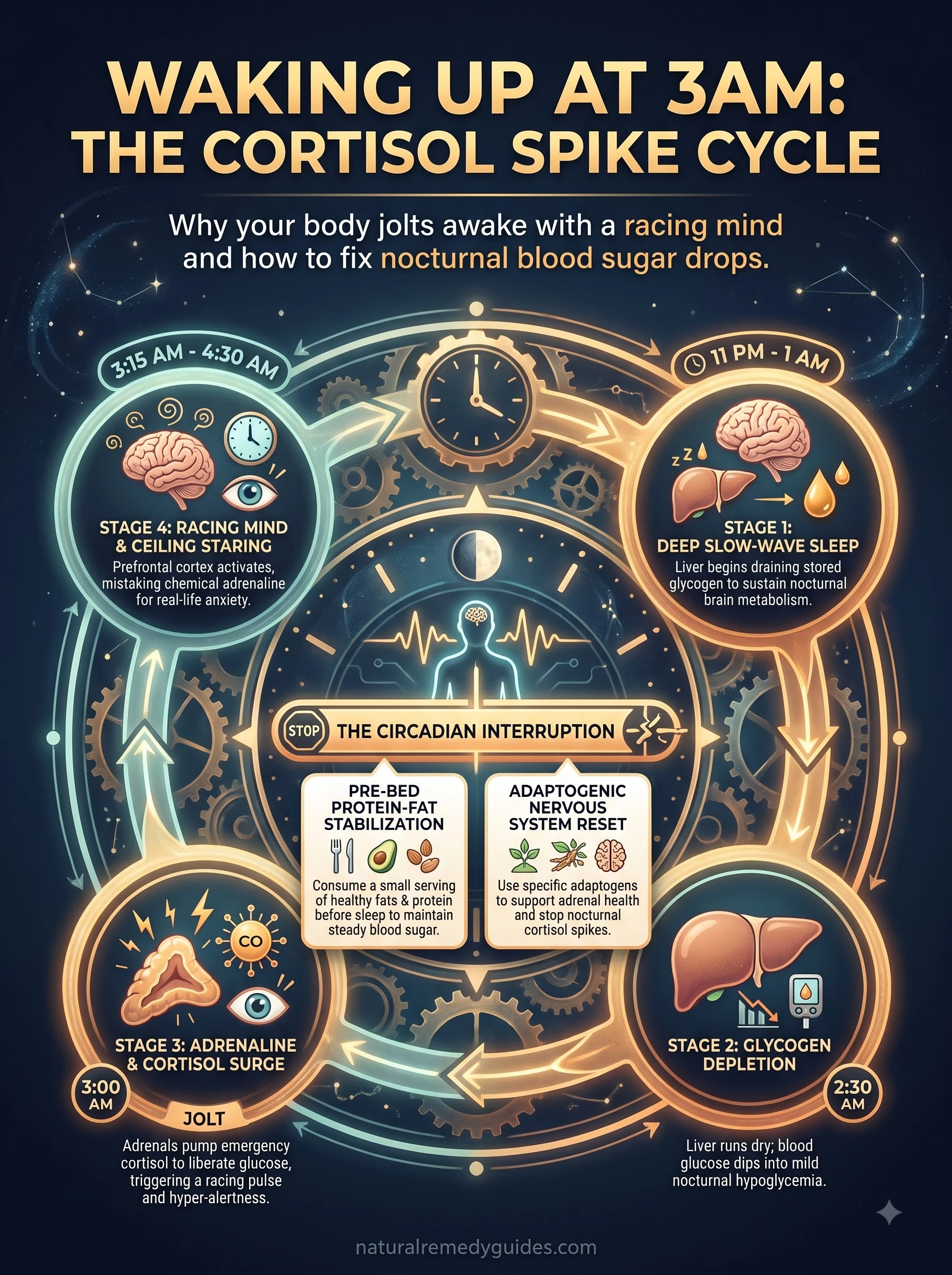
What it is: Experiencing a waking up at 3am cortisol spike is an involuntary neuroendocrine arousal triggered when dropping nocturnal blood sugar prompts the adrenal glands to release emergency cortisol and epinephrine.
Does it work: Yes. Stabilizing bedtime glycogen stores with a small protein-fat snack and applying clinical stimulus-control conditioning restores uninterrupted sleep without habit-forming pills.
The evidence: Clinical trials (PMID 17400929 and PMID 12627733) confirm that nocturnal hypoglycemia provokes rapid autonomic arousals, while multimodal CBT-I reduces wakefulness after sleep onset by 26 minutes (PMID 26054060).
Verdict: The INSOMNIAC sleep therapy system provides the definitive drug-free roadmap to retrain your sleep architecture, quiet middle-of-the-night mental chatter, and break 3 AM wake cycles with a complete 60-day satisfaction guarantee.
A sudden waking up at 3am cortisol spike leaves you staring at the bedroom ceiling in total frustration. Your eyes snap open in the pitch dark. Your heart thumps rapidly against your ribs. Your sheets feel warm and damp from a sudden flash of perspiration. You glance toward the nightstand clock, watching the digital numbers glow 3:14 AM.
Immediately, your brain starts spinning. You calculate how many hours remain before your morning alarm rings. You review an awkward email from yesterday. You fret about bills, deadlines, and family obligations. Within ninety seconds, your nervous system feels completely charged, as if somebody poured three shots of dark espresso down your throat while you slept.
You did not drink coffee before bed. You went to sleep exhausted at 10:30 PM. Why does your body repeatedly sound a five-alarm panic siren at the exact same hour every single night?
The answer is not a lack of willpower, bad luck, or poor bedroom curtains. It is a biological ambush driven by two synchronized biological triggers: nocturnal glycogen depletion and an overactive stress response system.
Break the 3 AM Night Awakening Cycle Without Habit-Forming Drugs
Discover the INSOMNIAC Sleep Restoration Program →Evidence-based CBT-I protocol • 100% money-back guarantee for 60 days • Instant digital access
Why a Waking Up at 3am Cortisol Spike Shatters Sleep Architecture
To stop middle-of-the-night awakenings, you must first understand how human sleep changes across the night. Your sleep is not a flat, uniform block of unconsciousness. It moves through recurring 90-minute waves, shifting between deep slow-wave delta sleep and rapid-eye-movement (REM) dream states.
During the first third of your night (roughly 10:00 PM to 2:00 AM), your brain prioritizes deep physical recovery. Growth hormone surges. Muscle tissue repairs itself. In this phase, your sensory gates remain firmly shut. Heavy trucks driving outside or distant thunder rarely wake you.
However, between 2:30 AM and 4:00 AM, your internal sleep architecture undergoes a dramatic structural transition:
- The Deep Sleep Drop-Off: Your requirement for deep slow-wave sleep is mostly satisfied within the first four hours. Past 2:30 AM, your brain switches into lighter Stage 2 sleep and extended REM cycles. In this lighter phase, your sensory arousal threshold drops significantly.
- The Circadian Cortisol Incline: Under normal conditions, your baseline cortisol level hits its lowest daily trough around midnight. Between 2:00 AM and 3:00 AM, your adrenal glands begin a slow, gentle upward ramp to prepare your body for morning waking. In a healthy nervous system, this rise is gradual and stays far beneath the threshold of conscious awareness.
- The Fragile Bridge: Because your sleep is naturally lighter at 3 AM, any sudden surge in stress chemistry will instantly punch you through the sleep barrier into full waking alertness.
In controlled sleep laboratory investigations evaluating nocturnal endocrine reactions, researchers demonstrated that drops in nocturnal blood glucose trigger an immediate counter-regulatory autonomic surge. Epinephrine and cortisol secretion spike sharply, preceding EEG-verified cortical awakenings. The body treats dropping nocturnal glucose as an emergency metabolic threat, pulling individuals out of light REM sleep into a state of hyper-arousal.
The 3 AM Ambush: Nocturnal Glycogen Dips and Adrenaline Surges
Why does that gentle morning cortisol ramp turn into an explosive spike at 3:00 AM? The primary culprit is often your liver.
Think of your liver as a biological fuel tank that stores roughly 80 to 100 grams of glucose in the form of glycogen. While you sleep, your brain consumes an enormous quantity of glucose to process memories, clean neural waste, and regulate breathing. Your muscles rest, but your brain never stops burning fuel.
If you ate an early dinner, consumed alcohol in the evening, or ate a high-sugar meal that caused an insulin crash, your liver's glycogen reserves drain out around 3:00 AM. Your circulating blood sugar begins to drop. In medical terms, this mild drop is known as nocturnal hypoglycemia.
Your brain interprets a sudden drop in fuel supply as an immediate survival emergency. If glucose drops too low, brain cells starve. To prevent this, your brain fires an urgent distress signal down the hypothalamic-pituitary-adrenal (HPA) axis.
Your adrenal glands respond by dumping two powerful counter-regulatory survival hormones into your blood: epinephrine (adrenaline) and cortisol.
Adrenaline commands your liver to rapidly break down proteins and fats to create emergency glucose. But adrenaline also triggers your primitive fight-or-flight response. Your heart accelerates. Your blood pressure climbs. Your body temperature rises. Your brain shifts into intense survival vigilance. You jolt awake feeling wide-eyed, tense, and deeply unsettled.
Comparing Night Awakening Remedies: Root Causes vs. Conventional Traps
Millions of people caught in this night-waking cycle reach for drugstore remedies. The table below illustrates how different sleep interventions compare when addressing 3 AM awakenings:
| Approach | Mechanism | Impact on 3 AM Waking | Downsides & Risks |
|---|---|---|---|
| Cognitive Behavioral Protocol (CBT-I) | Breaks conditioned bedroom anxiety; resets circadian sleep drive and stimulus cues | Reduces wakefulness after sleep onset by 26 minutes (PMID 26054060) | Requires 2 to 3 weeks of structured routine adjustment |
| OTC Sleep Aids (Diphenhydramine) | Blocks central histamine H1 receptors to induce synthetic drowsiness | Metabolizes in 4 hours; triggers severe 3 AM rebound awakenings | Dry mouth, daytime brain fog, rapid tolerance, and grogginess |
| High-Dose Melatonin (5mg–10mg) | Floods receptors with supraphysiological hormone levels | Helps sleep onset only; zero effect on nocturnal liver glycogen or cortisol | Vivid nightmares, desensitized receptors, and disrupted circadian timing |
| Bedtime Fuel Buffer (Fat + Protein) | Provides sustained, slow-burning fatty acids to stabilize nocturnal blood sugar | Prevents nocturnal adrenaline dump by keeping glycogen stable through 4 AM | Must be paired with nervous system down-regulation for complete relief |
Why Drugstore Sleeping Pills Make 3 AM Awakenings Worse
When you cannot stay asleep, taking an over-the-counter pill feels like the fastest escape. Popular sleeping aids rely on first-generation antihistamines like diphenhydramine or doxylamine. While these sedatives can knock you out quickly at 10:30 PM, they set you up for a worse awakening later in the night.
First, these compounds have a biological half-life that peaks early. By 3:00 AM, their sedative action drops off sharply. As the drug clears your neural receptors, your brain experiences a rebound surge in alerting neurochemicals. This rebound coincides with your natural circadian cortisol incline, doubling the intensity of your awakening.
Second, chemical sedatives suppress slow-wave delta sleep and crush REM dream states. You may remain unconscious, but your brain misses out on critical neurochemical restoration. You wake up feeling hungover, mentally sluggish, and chemically drained.
Third, relying on pills creates psychological dependence. You begin to believe that your body has lost its innate ability to sleep naturally. That belief fuels evening performance anxiety, keeping your baseline cortisol elevated before you even climb into bed.
Reclaim Natural, Deep Sleep Without Next-Day Grogginess
Learn How the INSOMNIAC Method Restores Deep Sleep →Backed by 60-day satisfaction guarantee • Step-by-step cognitive protocols • Used by thousands worldwide
The 3 Bedside Rules When You Wake Up Tonight
If you find yourself awake at 3:00 AM tonight, how you react in the first ten minutes will determine whether you drift back to sleep or stay awake until dawn. Follow these three clinical bedside rules:
- Never Check the Clock or Touch Your Phone: Checking the time triggers instant anxiety math. You think: "It is 3:20 AM. I have to wake up at 6:30 AM. That leaves three hours and ten minutes." That single thought sparks a fresh wave of adrenaline. Glancing at a glowing phone screen blasts your retinas with blue photons, shutting down remaining melatonin production. Turn your alarm clock toward the wall and leave your phone in another room.
- The 20-Minute Bed Reset Rule: If you toss and turn for more than twenty minutes, your brain begins associating your mattress with frustration, wakefulness, and stress. Break this mental loop. Slip quietly out of bed, move to a dimly lit chair in another room, and read a dry, physical book under soft amber light. Do not eat, watch television, or clean the kitchen. Return to bed only when your eyelids feel heavy.
- The 4-7-8 Parasympathetic Vagal Reset: When your heart pounds at 3 AM, your sympathetic nervous system is locked in drive. You cannot think your way into relaxation; you must use biomechanics. Breathe in quietly through your nose for 4 seconds. Hold your breath gently for 7 seconds. Exhale slowly through your mouth with a soft whoosh for 8 seconds. Repeating this cycle four times slows your heart rate and stimulates your vagus nerve, blunting the cortisol surge.
The Long-Term Fix: The INSOMNIAC Circadian Retraining Protocol
While bedside techniques provide immediate damage control, putting an end to 3 AM wakeups requires retraining your nervous system and circadian rhythms from the ground up.
This is where INSOMNIAC (The Ultimate Sleep Therapy) provides a clear, systematic advantage. Rather than masking symptoms with synthetic pills, this comprehensive program uses evidence-based Cognitive Behavioral Therapy for Insomnia (CBT-I) principles. Clinical trials published in the Annals of Internal Medicine confirm that CBT-I delivers lasting reductions in nocturnal wakefulness that endure long after treatment ends.
The program guides you through a clear, actionable transformation:
- Stimulus Control Conditioning: Sever the toxic link between your bed and nighttime anxiety, rebuilding your mattress as a trigger for rapid, deep sleep.
- Circadian Phase Anchoring: Learn how simple morning light timing and consistent wake anchors set your master biological clock, ensuring high melatonin production when your head hits the pillow.
- The Nocturnal Fuel Blueprint: Discover exactly what small evening protein-fat snacks (such as a spoonful of raw almond butter or a handful of walnuts) stabilize liver glycogen to prevent midnight adrenaline alarms.
- Cognitive De-escalation Tools: Master proven daytime mental unwinding techniques to clear looping thoughts before bedtime, keeping your evening cortisol levels low.
Wake Up Rested and Refreshed: Begin Your Sleep Recovery Today
Access the Complete INSOMNIAC Sleep Therapy Program →Immediate digital access • 100% money-back guarantee for 60 days • Clinical sleep science made simple
You do not have to accept 3 AM ceiling-staring as your permanent reality. Your body possesses an extraordinary innate capacity for deep, restorative rest. When you eliminate nocturnal blood sugar crashes, calm an overworked nervous system, and follow proven behavioral sleep protocols, your sleep cycles flow smoothly through the night. For additional natural wellness strategies, explore our foundational guide on Overcoming Insomnia Naturally: Evidence-Based Sleep Restoration.
Natural Remedy Guides editorial content is reviewed for scientific accuracy. Clinical references: PubMed PMIDs 17400929, 12627733, 26054060, 18854200.
Scientific References & Clinical Literature
- Jauch-Chara K, Hallschmid M, Gais S, et al. Awakening and counterregulatory response to hypoglycemia during early and late sleep. Diabetes. 2007;56(7):1938-1942. PMID: 17400929
- Gais S, Born J, Peters A, et al. Hypoglycemia counterregulation during sleep. Sleep. 2003;26(1):55-59. PMID: 12627733
- Trauer JM, Qian MY, McMaugh JS, et al. Cognitive Behavioral Therapy for Chronic Insomnia: A Systematic Review and Meta-analysis. Ann Intern Med. 2015;163(3):191-204. PMID: 26054060
- Fries E, Dettenborn L, Kirschbaum C. The cortisol awakening response (CAR): facts and future directions. Int J Psychophysiol. 2009;72(1):67-73. PMID: 18854200
Independent Wellness Research & Editorial Standards
Our Wellness Research Approach: We explore publicly available scientific literature, nutritional research, botanical studies, and traditional wellness practices to help readers understand natural supplements and healthy lifestyle habits. Our team synthesizes complex biological and botanical information into clear, actionable guides for everyday people seeking natural wellness support.
Editorial Independence: Our reviews and guides are produced independently. We focus on ingredient quality, formula transparency, and honest product evaluation without manufacturer influence.
Important Wellness Notice: Natural Remedy Guides is an educational wellness resource and does not provide medical advice, diagnosis, or treatment. Dietary supplements are not intended to diagnose, treat, cure, or prevent any medical condition. Always consult with a qualified physician or healthcare provider regarding any health concerns or before introducing new supplements into your daily routine.