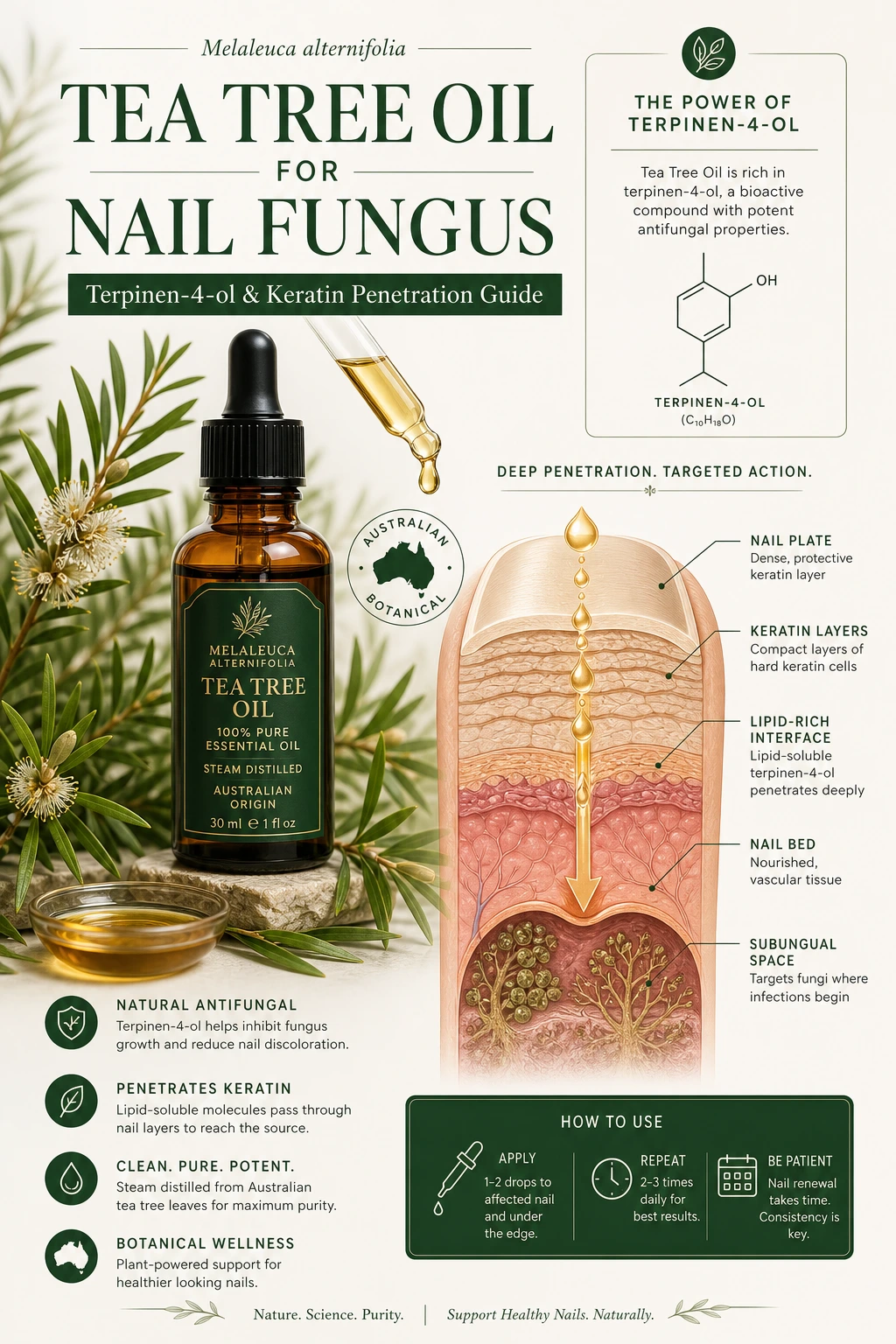
The Bottom Line: Using tea tree oil for nail fungus provides real, evidence-backed fungal relief without the liver concerns tied to prescription pills. Its primary active fraction, terpinen-4-ol, breaks down fungal cell walls on contact. But pure essential oil can burn sensitive skin. The smart approach pairs standardized tea tree with skin-friendly carrier lipids like undecylenic acid and lavender oil to reach deep under the nail bed.
Who It Is Best For: Anyone struggling with yellow, crumbly, or thick toenails seeking a safe, plant-based regimen that spares the liver.
The Reality Check: Toenails grow at a crawl of just 1.5 millimeters each month. Erasing fungal damage requires daily application for three to six months until clear nail replaces the old plate.
Starting your research into tea tree oil for nail fungus usually happens when you grow tired of hiding your feet. You look down in the shower. You spot that familiar, stubborn yellow streak on your big toe. The nail feels thick, brittle, and rough around the edges. You avoid wearing open-toe shoes. You skip sandals at the beach. You wonder why over-the-counter drugstore ointments never seem to make a dent. It is frustrating. Feet should feel healthy.
Most commercial drugstore creams fail for a simple physical reason. They are water-based lotions made for soft skin. Your toenail is not soft skin. It is tough. It is a dense shield of hard keratin shingles designed to repel water. Lotions simply sit on top, dry up, and rub off on your socks. Meanwhile, the fungal spores continue living undisturbed in the warm nail bed underneath. They keep growing.
That frustrating barrier explains why natural health practitioners turn to Australian tea tree oil. Extracted from the leaves of Melaleuca alternifolia, this fragrant botanical oil is naturally fat-soluble. It slips through tiny micro-cracks in the nail plate to reach the root of the problem.
Reclaim Clear, Strong, Natural Nails Without Harsh Chemicals
Check Official Kerassentials Availability & Discount Pricing →Backed by a 100% money-back guarantee for 60 days • Physician-formulated botanical lipid matrix • Free US delivery
The Science of Terpinen-4-ol: How Tea Tree Oil Stops Nail Fungus
Why does tea tree oil for toenail fungus command so much scientific attention? The answer lies in its rich chemical profile. Pure tea tree oil contains more than one hundred distinct plant terpenes. But one specific component does the heavy lifting: terpinen-4-ol. It is potent.
High-grade Australian tea tree oil contains at least 35% to 40% terpinen-4-ol by weight. When this compound touches fungal cells, it targets ergosterol. Ergosterol is the biological glue holding fungal cell membranes together. Terpinen-4-ol dissolves this lipid glue. The protective outer membrane develops microscopic leaks, internal nutrients spill out, and the fungal cell quickly dies. It stops spore replication cold. The cell collapses.
Fungi thrive in warm, dark, damp shoes. They feed on keratin protein, breaking it down into a crumbly, powdery mess. Terpinen-4-ol starves them by destroying their cellular integrity before they can produce more keratin-digesting enzymes. It cuts off their food supply.
A landmark scientific review published in Clinical Microbiology Reviews (PMID: 16418522) established that the terpinen-4-ol fraction in tea tree oil compromises fungal cell membrane permeability, causing extensive cellular leakage and halting dermatophyte proliferation across skin and keratin barriers.
Human Clinical Trials: Does Tea Tree Oil Cure Toenail Fungus?
People often ask a fair question: does tea tree oil cure toenail fungus in actual human testing? Laboratory petri dishes are one thing. Real human feet inside hot socks are another. Feet face daily friction. Fortunately, researchers put this exact question to the test in formal trials. Real people participated.
In a randomized, double-blind trial published in the Journal of Family Practice (PMID: 8195735), researchers followed 117 patients with chronic fungal nail infections over six months. One group applied 1% clotrimazole, a standard prescription pharmaceutical cream. The other group used 100% pure tea tree oil twice daily. At the study conclusion, the natural tea tree oil group matched the pharmaceutical cream step for step. Both treatments achieved roughly 60% full nail clearance and marked symptomatic relief. It proved real-world efficacy.
A second trial published in Tropical Medicine & International Health (PMID: 10357864) combined tea tree oil with complementary topical agents. That study documented an impressive 80% clinical resolution rate, with completely negative fungal laboratory cultures and zero recorded relapses during eight months of careful post-trial observation. The trial evidence is clear: tea tree oil works when applied properly and consistently. Daily habits matter.
Head-to-Head Comparison: Tea Tree Oil vs Standard Alternatives
When selecting a treatment, seeing how natural botanical oils stack up against common alternatives helps you pick the right tool for your body:
| Approach | Active Substance | Nail Plate Delivery | Safety Profile |
|---|---|---|---|
| 100% Raw Tea Tree Oil | Pure Melaleuca extract | Moderate lipid absorption | Can trigger contact skin redness and peeling |
| Drugstore Creams | Clotrimazole, Tolnaftate | Poor; water base repelled by keratin | Low toxicity, but poor long-term success |
| Oral Prescription Pills | Terbinafine, Itraconazole | Travels via bloodstream | Requires routine blood tests to check liver enzymes |
| Synergistic Lipid Oil Matrix | Tea tree, Undecylenic acid, Clove, Lavender | High; multi-oil lipid blend seeps under nail folds | Gentle on surrounding skin; zero liver strain |
Why Pure Raw Tea Tree Oil Has One Major Drawback
If tea tree oil works so well, why not just pour a bottle of 100% pure essential oil straight over your toes? That sounds logical. But real-world experience reveals a common pitfall. Pure oils are strong.
Pure tea tree oil is extraordinarily potent. When applied completely undiluted twice daily onto the delicate skin of the surrounding cuticle and toe folds, raw oil frequently triggers stubborn contact redness, burning, and uncomfortable peeling. Your skin turns red. It burns. It cracks open. It stings. When skin cracks, bacteria can sneak in, creating secondary discomfort. That forces people to stop applying it long before the fungus clears. Nobody wants raw skin.
That is why botanical formulators blend standardized tea tree oil with soothing lipid carriers. Ingredients like sweet almond oil, organic flaxseed oil, and aloe vera cushion delicate skin. They soothe irritation. Meanwhile, adding complementary soothing botanicals like clove bud oil and FDA-recognized undecylenic acid creates a broad defense shield that hits stubborn fungal spores from multiple biological angles at once. It feels gentle.
Realistic Expectations: Tea Tree Oil Nail Fungus Before and After
Understanding the timeline for tea tree oil nail fungus before and after changes keeps you from giving up too soon. Fungus does not vanish overnight. It takes time. Stay patient. Nails grow slowly.
Here is what a realistic recovery timeline looks like when following a disciplined daily routine:
- Weeks 1 to 4: Thick, crumbling edges begin softening. The unpleasant odor caused by fungal byproducts disappears. The skin around your cuticle calms down and looks healthier. It looks calmer.
- Weeks 5 to 12: A clear, smooth band of fresh pink nail appears at the lunula (the half-moon at the base of your toe). This is your first visual proof of progress. The infected yellow portion gets pushed forward toward the tip. Progress is real.
- Months 4 to 6: You trim away brittle discolored tips during regular grooming. Clear, strong keratin now covers two-thirds of your nail bed. It feels stronger.
- Months 7 to 9: The damaged nail is completely gone. A fresh, healthy, natural nail plate has grown out from base to edge. Your toenail looks clean.
How to Use Tea Tree Oil for Toenail Fungus: The 4-Step Protocol
Knowing how to use tea tree oil for toenail fungus properly makes all the difference between frustrating stagnation and steady progress. Follow these four daily steps. Consistency wins.
- Thin the Dead Keratin: After a warm shower, use a fresh disposable emery board to gently file down the top surface of thickened nail tissue. This removes dead barrier layers so the oil penetrates deeper. Never share files between healthy and infected toes. Be gentle.
- Dry Thoroughly: Fungi love damp environments. Dry your toes thoroughly with a clean paper towel. Let them air dry for three minutes before applying your oil. Moisture feeds fungus. Keep toes dry.
- Apply Under and Around the Nail: Use a precision dropper or applicator brush. Apply the restorative oil blend thoroughly across the top of the nail plate, along both sensitive side cuticle grooves, and directly under the open free edge of the toe. Let it absorb for five minutes. Do not rush.
- Wear Breathable Footwear: Switch from synthetic socks to breathable cotton, merino wool, or bamboo. Synthetic fabrics trap sweat and feed fungal colonies. Spray your shoes regularly to prevent reinfection. Air them out.
Give Your Nails the Deep Botanical Nourishment They Need
Order Kerassentials Directly from the Official Lab →Zero harsh pharmaceuticals • 15-in-1 botanical oil blend • 60-day unconditional refund policy
The Bigger Picture: Keeping Fungus from Spreading
Fungal nail infections rarely stay isolated forever. If left unmanaged, active spores often migrate across the cuticle border into adjacent toe skin, triggering itchy athlete's foot. Understanding why toenail fungus spreads to skin helps you catch barrier breakdowns early before surrounding tissue becomes irritated.
Choosing a comprehensive nail fungus treatment that works requires matching your remedy to human biology. By utilizing deep-penetrating lipid oils like tea tree and undecylenic acid, you supply continuous natural defense throughout the entire nail regrowth cycle. Consistent daily care restores strong, smooth, confident nails you will feel proud to show off.
Frequently Asked Questions About Tea Tree Oil for Nail Fungus
Does tea tree oil cure toenail fungus permanently?
Tea tree oil neutralizes active fungal colonies, but it cannot repair dead keratin retroactively. Permanent clearance happens when you protect the nail bed daily until fresh, clean nail tissue grows out completely from the root.
Can I apply 100% pure tea tree oil straight to my toes?
Dabbing 100% pure tea tree oil onto thin skin folds often triggers stinging, contact redness, and peeling. Blending it with soothing lipid oils like jojoba, almond, and undecylenic acid protects surrounding skin while driving deep penetration.
What should I expect for tea tree oil nail fungus before and after results?
In the first month, yellow brittleness softens and foul odor fades. Around month three, a visible band of pink, clear nail begins pushing upward from the cuticle. Total clearance finishes once the old nail grows out entirely.
Experience Clean, Healthy Toenails Again with Kerassentials
Claim Your Kerassentials Discount Package Here →Manufactured in the USA in a cGMP facility • 60-day 100% money-back guarantee
Scientific References & Clinical Studies
- Buck DS, Nidorf DM, Addino JG. Comparison of two topical preparations for the treatment of onychomycosis: Melaleuca alternifolia (tea tree) oil and clotrimazole. J Fam Pract. 1994;38(6):601-605. PMID: 8195735
- Syed TA, Qureshi ZA, Ali SM, et al. Treatment of toenail onychomycosis with 2% butenafine and 5% Melaleuca alternifolia (tea tree) oil in cream. Trop Med Int Health. 1999;4(4):284-287. PMID: 10357864
- Carson CF, Hammer KA, Riley TV. Melaleuca alternifolia (Tea Tree) oil: a review of antimicrobial and other medicinal properties. Clin Microbiol Rev. 2006;19(1):50-62. PMID: 16418522
- Elewski BE. Onychomycosis: Pathogenesis, diagnosis, and management. Clin Microbiol Rev. 1998;11(3):415-429. PMID: 9665975
Independent Wellness Research & Editorial Standards
Our Wellness Research Approach: We explore publicly available scientific literature, nutritional research, botanical studies, and traditional wellness practices to help readers understand natural supplements and healthy lifestyle habits. Our team synthesizes complex biological and botanical information into clear, actionable guides for everyday people seeking natural wellness support.
Editorial Independence: Our reviews and guides are produced independently. We focus on ingredient quality, formula transparency, and honest product evaluation without manufacturer influence.
Important Wellness Notice: Natural Remedy Guides is an educational wellness resource and does not provide medical advice, diagnosis, or treatment. Dietary supplements are not intended to diagnose, treat, cure, or prevent any medical condition. Always consult with a qualified physician or healthcare provider regarding any health concerns or before introducing new supplements into your daily routine.