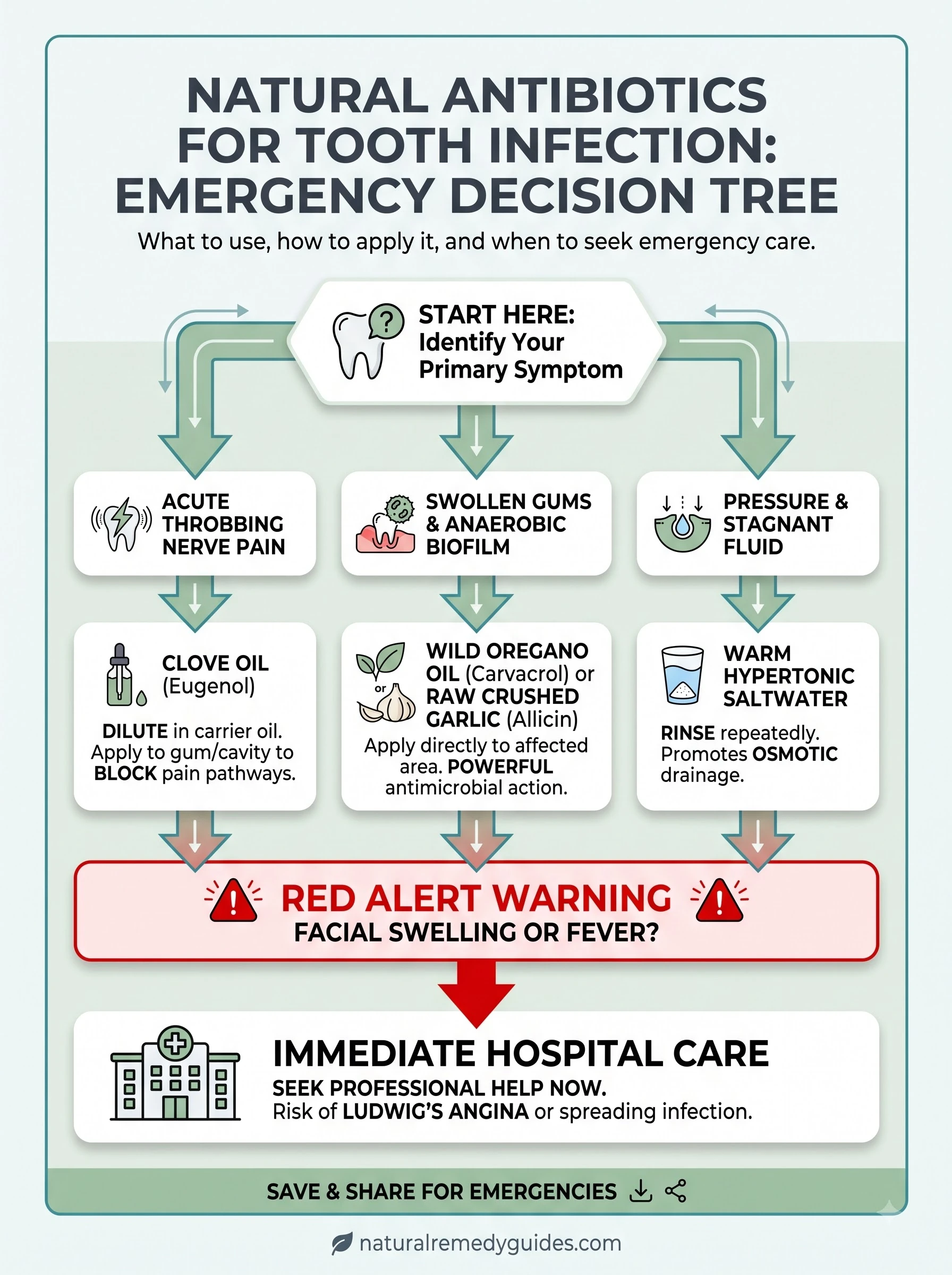
What it is: Exploring natural antibiotics for tooth infection involves utilizing plant-derived antimicrobials—such as clove eugenol, oregano carvacrol, and raw garlic allicin—to suppress bacterial biofilms and soothe acute pulp inflammation.
Does it work: Partially. Natural antimicrobials demonstrate potent lab-verified bactericidal efficacy against oral pathogens and provide acute pain relief. However, they cannot sterilize a necrotic, closed tooth canal.
The evidence: Clinical trials and microbiologic evaluations (PMID: 21867990, PMID: 25153862, PMID: 28839088, and PMID: 30101538) confirm that eugenol and carvacrol disrupt oral bacterial membranes and suppress swelling during acute dental emergencies.
Verdict: When you are stranded off-grid, traveling remotely, or facing delayed emergency care, The Home Doctor: Practical Medicine for Every Household provides indispensable physician-written protocols to stabilize acute infections safely.
Searching for natural antibiotics for tooth infection often starts in the middle of the night. A low, rhythmic throbbing builds behind your lower jaw. Within two hours, each heartbeat sends a jagged lightning bolt into your cheekbone. Cold water makes you wince in agony. Biting down feels like chewing on broken glass. To make matters worse, it is Saturday night, and your family dentist is closed until Monday morning.
You need relief fast. Fear and pain drive millions of people to their kitchen cupboards.
Can household botanicals really fight off a dangerous dental abscess? The answer demands honest biological nuance. While certain plant compounds exert remarkable antimicrobial power, misunderstanding tooth anatomy can lead to dangerous systemic complications. Here is the unvarnished clinical reality of managing tooth infections naturally.
The Anatomy of a Tooth Abscess: Why Teeth Resist Treatment
To understand why dental infections are notoriously difficult to control, you must examine tooth histology.
Your tooth is not a simple solid bone. It is an encased biological fortress. The outer layer consists of mineralized enamel, the hardest substance in the human body. Beneath the enamel lies porous dentin, honeycombed with thousands of microscopic tubules leading directly toward the center: the dental pulp chamber.
Inside that narrow pulp chamber run sensitive sensory nerves, arterioles, and venules. When dental caries breach the enamel, opportunistic oral bacteria invade this warm, dark space.
Here is where standard physiology breaks down.
Anywhere else in your body, an infection triggers inflammatory vasodilation. Blood vessels expand, flooding the region with white blood cells, lymphatic fluid, and oxygen. Tissues swell outward comfortably. But inside a rigid tooth, pulp tissue cannot expand. Swelling crushes the tiny blood vessels entering through the microscopic apical foramen at the root tip.
The blood supply suffocates. The pulp tissue dies.
Once the tooth nerve becomes necrotic, there is zero internal blood circulation left. Systemic prescription antibiotics delivered through your bloodstream struggle to penetrate a dead, hollow tooth chamber. Similarly, surface mouthwashes cannot seep deep into the jawbone. Bacteria multiply unhindered, creating pressurized pus that eats away jawbone at the root tip—forming a periapical abscess (PMID: 30101538).
This is why natural botanicals must be understood correctly: they are emergency stabilization tools, not permanent dental substitutes.
Top 4 Natural Antibiotics for Tooth Infection: Clinical Evidence
When professional clinical care is physically out of reach, evidence-based herbal antimicrobials can suppress surface bacterial replication, calm inflamed gingival margins, and blunt agonizing nerve pain.
| Antimicrobial Agent | Active Chemical Compound | Primary Mechanism | Clinical Strength | Key Safety Caution |
|---|---|---|---|---|
| Clove Oil | Eugenol (70–90%) | Blocks sodium channels; lyses bacterial membranes | Very High (Analgesic) | Must dilute; burns bare oral tissue |
| Wild Oregano Oil | Carvacrol & Thymol | Permeabilizes bacterial cell walls; biofilm disruption | Very High (Broad-spectrum) | Extremely caustic; avoid swallowing undiluted |
| Crushed Raw Garlic | Allicin (enzymatic) | Inactivates thiol-containing microbial enzymes | Moderate to High | Direct contact causes severe chemical burns |
| Hypertonic Salt Water | Sodium Chloride (NaCl) | Osmotic draw; flushes necrotic debris and pus | Mechanical & Cleansing | Temporary osmotic relief only |
1. Clove Oil (Eugenol): The Gold Standard Natural Dental Anesthetic
Modern dentistry still relies on eugenol in temporary zinc oxide cements. Extracted from the buds of Syzygium aromaticum, eugenol penetrates porous dentinal tubules rapidly. It inhibits voltage-gated sodium channels along sensory nerve fibers, shutting down acute pain transmission within minutes (PMID: 21867990).
Simultaneously, eugenol displays potent bactericidal activity against Streptococcus mutans and Porphyromonas gingivalis by degrading lipid bilayer structures.
2. Wild Oil of Oregano (Carvacrol): The Heavy-Duty Biofilm Destroyer
Wild Mediterranean oregano oil contains high concentrations of phenolic monoterpenes, predominantly carvacrol and thymol. In laboratory assays, carvacrol dismantles complex oral anaerobe biofilms that typical mouthwashes slide right over (PMID: 25153862). It rapidly destabilizes bacterial cell walls, causing cytoplasmic leakage.
3. Freshly Crushed Garlic (Allicin): Nature's Reactive Thiol Blocker
Whole, intact garlic cloves contain no active allicin. Only when you crush or slice the clove does the internal enzyme alliinase convert alliin into volatile, pungent allicin. Allicin reacts with essential sulfur-containing thiol groups inside bacterial enzymes, blocking microbial metabolism and DNA replication (PMID: 28839088).
Caution: Never place raw, crushed garlic directly against your gums overnight. It induces painful chemical necrosis and skin ulceration.
4. Warm Hypertonic Saltwater Rinses: The Gentle Osmotic Flush
Dissolving one teaspoon of unrefined salt into eight ounces of warm water creates a hypertonic oral bath. Osmotic pressure draws stagnant inflammatory fluid out of swollen gingival tissues. It cleanses loose food particles, alkalizes oral pH, and prevents anaerobic bacteria from thriving.
Red-Flag Warning Signs: When a Tooth Infection Becomes Life-Threatening
You cannot cure an internal root abscess at home forever. If infection escapes the tooth root and penetrates deep fascial spaces in the head and neck, it becomes a medical emergency. Watch for these danger signs:
- Facial Asymmetry or Eye Swelling: Swelling extending into your cheek, upper eye socket, or temple indicates spreading cellulitis.
- Difficulty Swallowing or Breathing (Ludwig's Angina): Infection tracking down the floor of the mouth can compress your airway within hours. This requires immediate hospital trauma triage.
- High Fever and Chills: Systemic bacteremia or early sepsis.
- Sudden Pain Relief Accompanied by Foul Taste: When agonizing tooth pressure abruptly ceases and a salty, foul liquid floods your mouth, the abscess has ruptured into your oral tissues. While pain drops temporarily, the underlying microbial colony remains active.
Emergency Off-Grid Management: When Medical Help Is Truly Unavailable
What happens if you are trapped in a natural disaster, stranded during remote travel, or facing severe economic disruption where emergency dental services simply do not exist?
In austere conditions, surviving a dental emergency requires structured clinical triage. You must know how to sterilize improvised instruments, safely drain fluctuant gum swellings, manage acute pain without destroying stomach lining, and assemble emergency antibiotic reserves before catastrophe strikes.
The Home Doctor: Practical Medicine for Every Household
Written by practicing frontline medical doctors, The Home Doctor is an indispensable 304-page medical field manual designed for real-world crises. It provides step-by-step instructions on treating severe tooth infections, managing acute dental abscesses off-grid, identifying essential household medicines, and providing life-saving medical care when emergency services cannot reach you.
- Dental Emergency Protocols: How to safely numb severe tooth pain and manage abscessed teeth when dentists are unavailable.
- Emergency Antibiotic Guide: Stockpiling and utilizing legal, over-the-counter medical alternatives safely.
- Wound Care & Infection Control: Physician-tested methods to prevent localized infections from turning septic.
Backed by a full 60-day 100% money-back guarantee. Ships direct to your doorstep.
For additional emergency medical triage and practical home preparedness strategies, explore our full Survival Medical Guide to learn how front-line emergency protocols safeguard your entire family.
Disclaimer: This article is for educational purposes only and does not constitute formal medical or dental advice. If you experience facial swelling, fever, or difficulty swallowing, seek emergency medical attention immediately.
Independent Wellness Research & Editorial Standards
Our Wellness Research Approach: We explore publicly available scientific literature, nutritional research, botanical studies, and traditional wellness practices to help readers understand natural supplements and healthy lifestyle habits. Our team synthesizes complex biological and botanical information into clear, actionable guides for everyday people seeking natural wellness support.
Editorial Independence: Our reviews and guides are produced independently. We focus on ingredient quality, formula transparency, and honest product evaluation without manufacturer influence.
Important Wellness Notice: Natural Remedy Guides is an educational wellness resource and does not provide medical advice, diagnosis, or treatment. Dietary supplements are not intended to diagnose, treat, cure, or prevent any medical condition. Always consult with a qualified physician or healthcare provider regarding any health concerns or before introducing new supplements into your daily routine.