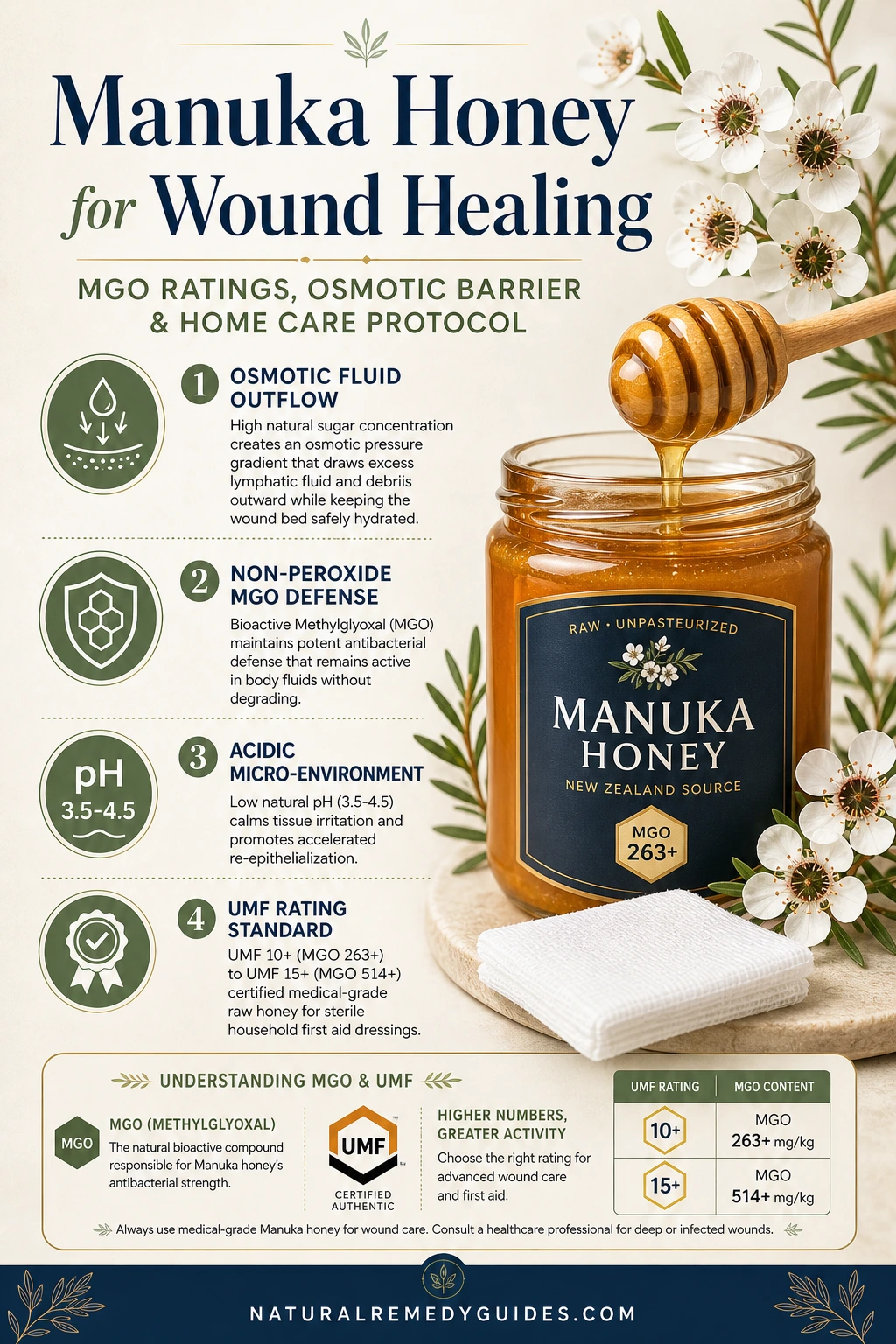
The Bottom Line: Certified medical-grade Manuka honey acts as an active physical barrier. It draws excess fluid out of swollen tissue, maintains protective acidity, and shields delicate skin cells from surface microbes.
Who It Is Best For: Families managing home first aid kits, outdoor enthusiasts, and individuals looking for non-irritating wound dressings for minor cuts, scrapes, and superficial burns.
The Reality Check: Grocery store honey is not sterile. Using table honey on broken skin risks introducing foreign spores. Always use gamma-sterilized medical honey with verified UMF 10+ or MGO 263+ potency.
Using manuka honey for wound healing is one of the most thoroughly proven natural first aid habits in modern biology. It happens in an instant. A sharp kitchen knife slips across your thumb. A bicycle fall scrapes your knee raw on hard gravel. Or a hot baking sheet sears your bare forearm.
You wash the cut. You open the cabinet. What goes on the raw skin?
For decades, standard household advice pointed toward greasy petroleum ointments. Yet modern wound science tells a very different story. Petroleum gels simply sit on top of raw tissue. They offer no active defense. In contrast, genuine medical-grade Manuka honey works with human biology. It creates a dynamic fluid shield that protects skin cells while shutting down bad bugs. Here is how to use nature's sweetest first aid tool safely at home.
Be Ready for Every Household Emergency When Help Is Delayed
Get The Home Doctor Emergency Handbook →Doctor-written household triage handbook • 60-day 100% money-back guarantee
How Manuka Honey Works: Osmotic Draw and Moisture Balance
All honey contains sweet natural sugars, and that simple biological fact is the exact reason why raw honey draws moisture out of swollen tissue so effectively.
Water naturally moves from areas of low sugar density toward areas of high sugar concentration, a physical law of nature that biologists call osmosis. Pure honey has almost no free water. Because of that, it pulls hard on nearby liquids. When you place sterile honey over an open scrape, it draws fluid upward from deeper skin layers.
Why does this outward fluid flow help healing?
First, the steady outflow of fluid lifts dirt particles, dead cells, and microscopic debris out of the wound base without requiring painful scrubbing or mechanical friction. Second, surface germs cannot grow without water. Honey pulls essential water molecules straight out of bacterial cells, causing microbial walls to collapse like deflated rubber balloons.
At the same time, honey stops bandages from drying out. Plain cotton gauze sticks tightly to open cuts, and whenever you peel off a dry bandage, you tear away fragile new skin cells and trigger fresh bleeding. Honey keeps the contact layer soft and slick. Dressings lift away cleanly without pain or tissue tears.
Methylglyoxal (MGO): Non-Peroxide Antibacterial Defense
Ordinary clover honey produces a tiny bit of hydrogen peroxide when diluted with water. But that peroxide breaks down fast. Light, air, and body enzymes destroy it in minutes.
Manuka honey is completely different. Honey bees collect sweet nectar from the wild Manuka bush (Leptospermum scoparium), native to New Zealand and southern Australia. The plant nectar holds high levels of dihydroxyacetone, which ripens into a potent natural compound called methylglyoxal (MGO).
MGO does not rely on fragile reactions. It delivers stable protection. It survives body heat, bright light, and fluid dilution without losing strength.
Lab tests show that MGO halts bacterial cell division and prevents harmful surface microbes from building sticky protective bio-films. Even tough antibiotic-resistant germs fail to resist high-MGO Manuka honey because the substance attacks bacterial walls across multiple pathways at once.
Clinical Evidence: Tissue Regeneration and Microbial Defense
A systematic review published in the International Wound Journal (PMID: 28901255) evaluated medical-grade honey across diverse wound types. Researchers reported that sterile Manuka honey sped up skin closure rates, cleared stubborn surface films, and reduced wound odor compared to standard paraffin dressings.
Further biomedical research in AIMS Microbiology (PMID: 24328701) confirmed that methylglyoxal (MGO) maintains strong antibacterial properties that do not fade in the presence of human catalase enzymes, confirming its unique reliability in acute wound care.
The Acid Mantle: How Low pH Protects Healing Tissue
Healthy human skin is naturally slightly acidic. It keeps an acid mantle with a pH near 5.5. But when skin tears open, deep tissue fluids leak out. These fluids raise the local pH to neutral or alkaline levels between 7.4 and 8.0.
An alkaline wound setting spells trouble.
Bad surface bugs thrive in neutral and alkaline settings. Worse yet, alkaline conditions switch on destructive enzymes that chew up newly formed collagen scaffolding and stall tissue repair.
Pure Manuka honey has a naturally low pH between 3.5 and 4.5, driven by organic gluconic acid. Spreading sterile honey over a raw cut turns the surface acidic at once. This quick shift calms swelling. It stops bug growth. It even helps red blood cells release fresh oxygen straight into starving tissue.
| Dressing Option | Antibacterial Mechanism | Moisture Retention | Biofilm Breakdown | Ideal Use Case |
|---|---|---|---|---|
| Medical Manuka (UMF 10+) | MGO + Osmotic pressure + Acidic pH | Optimal (prevents gauze stick) | Proven active breakdown | Minor cuts, scrapes, abrasions, burns |
| Raw Grocery Honey | Unstable low peroxide (Unsterile) | Good moisture | Minimal & unverified | Culinary only (Risk of spores) |
| Triple Antibiotic Ointment | Bacitracin / Neomycin / Polymyxin | Greasy barrier | Zero biofilm action | Short-term superficial cuts (Contact allergy risk) |
| Povidone-Iodine (Betadine) | Elemental iodine oxidation | Drying (damages new cells) | Moderate | Initial skin prep; harsh for ongoing tissue healing |
UMF vs. MGO: How to Choose Medical-Grade Honey
Browsing in a wellness shop or searching online reveals dozens of jars. Some claim "Active 20+". Others boast "MGO 400" or "UMF 15+". What do these numbers mean?
Two trusted grading systems prove you get real healing power:
- UMF (Unique Manuka Factor): The gold-standard independent label from the Unique Manuka Factor Honey Association. UMF checks three separate markers: methylglyoxal (antibacterial punch), leptosperin (authenticity proof), and DHA (shelf life).
- MGO (Methylglyoxal): Measures the exact milligrams of methylglyoxal per kilogram of honey. For example, MGO 400 means 400 mg of MGO per kilo.
Here is how the two grading scales match up:
- UMF 5+ (MGO 83+): Table grade. Great for tea and throat drops, yet too weak for dependable cut care.
- UMF 10+ (MGO 263+): The first medical level. Good for everyday paper cuts, fresh scrapes, and shallow grazes.
- UMF 15+ (MGO 514+): Medium-high strength. Ideal for tough road rash, garden scrapes, and minor burns.
- UMF 20+ (MGO 829+): Maximum strength. Saved for slow-healing cuts and stubborn wound issues.
Always look for the words "Medical Grade" or "Sterile" when treating open skin. Certified medical honey gets gentle gamma treatment. This wipes out dormant spores. It protects the fragile MGO compounds from heat damage.
Equip Your Home with Proven Emergency Protocols
Discover The Home Doctor First Aid System →Detailed off-grid medical guidance for households, families, and remote care
Step-by-Step Home Application Protocol
Putting honey on a fresh cut calls for clean, steady care. Here is the exact five-step home routine:
Step 1: Clean and Flush Well
Never put honey over loose dirt, sand, or gravel. Rinse the scrape under clean running tap water or sterile saline for two full minutes. Wash around the edges with gentle soap, but do not rub harsh soap inside raw tissue. Pat the dry skin nearby with clean gauze.
Step 2: Put Honey on the Pad, Not the Skin
Pouring thick honey straight onto a raw cut can sting. Don't do that. Instead, spread a smooth layer of honey directly onto a sterile non-stick pad. Spread it like butter on toast.
Step 3: Secure the Pad
Lay the honey pad right over the cleaned cut. Wrap it snugly with medical tape or rolled gauze. Honey thins out when warmed by body heat. A snug wrap keeps sticky fluid from dripping onto clothes or bed sheets.
Step 4: Change the Bandage
Check the wrap every day. If the dressing stays clean and dry, leave it alone for up to 48 hours. If fluid soaks through the outer gauze, take it off. Rinse gently with sterile saline, and put on fresh honey.
Step 5: Check Healing Signs
Within two to three days, healing skin should look clean, calm, and pale pink. Swelling should drop, and dressing changes should cause very little pain.
Manuka Honey for Minor Burns
Small stove burns and hot water scalds respond very well to sterile honey. When skin burns, heat damages tiny blood vessels and strips away the body's natural waterproof coat.
Follow these three steps for minor household burns:
- Cool First: Run cool tap water over the burn for ten full minutes. Cooling stops trapped heat from cooking deeper flesh. Never place honey on a burn that is still hot.
- Spread Gently: Once cool, spread a thick layer of medical Manuka honey over the reddened skin.
- Cover Loosely: Cover loosely with a sterile non-stick pad. Honey calms burning nerves and stops blisters from sticking to dry cloth fibers.
If you see large blisters, white leathery skin, or burns wider than three inches, get medical help right away. Home honey wraps are only meant for minor, first-degree burns.
Clinical References & Published Research
- PMID: 28901255 — Jull AB, et al. Honey as a topical treatment for wounds. Cochrane Database of Systematic Reviews. Clinical review documenting accelerated healing times and reduced pain during dressing changes.
- PMID: 24328701 — Alvarez-Suarez JM, et al. The composition and biological activity of honey: a focus on Manuka honey. Foods. Highlighting non-peroxide antibacterial mechanisms and MGO stability.
- PMID: 18639106 — Gethin G, Cowman S. Manuka honey vs. hydrogel: a prospective randomized clinical trial on wound desloughing. Journal of Clinical Nursing. Confirming osmotic debris clearance.
- PMID: 25680193 — Simon A, et al. Medical-grade honey in wound care. Current Problems in Dermatology. Analyzing honey acidity, low pH benefits, and safety profiles.
When Home Care Ends: Red-Flag Warning Signs
Natural remedies have clear boundaries. While Manuka honey works wonders for surface scrapes and small cuts, serious injuries require prompt doctor care.
Do not treat wounds at home if you notice any of these warning signs:
- Spurting Blood: Blood that pulses or fails to stop after ten minutes of firm, direct pressure needs emergency stitches.
- Deep Gaping Cuts: Wounds that split wide open to show yellow fat, muscle tissue, or bone must be stitched by a doctor within eight hours.
- Animal or Human Bites: Puncture bites push nasty mouth germs deep into flesh and require prescription medicine and professional care.
- Spreading Red Streaks or Fever: Red lines creeping up an arm or leg, hot skin spreading outward, foul yellow discharge, or high fever mean serious infection that needs immediate hospital care.
Knowing these safety boundaries is the heart of smart home care. To learn more practical skills for household health, check our companion guides on essential survival medical protocols, natural antibacterial remedies for dental emergencies, and activated charcoal for sudden food poisoning.
Take Charge of Your Family's Health & Emergency Readiness
Get The Home Doctor Practical Guide Today →Physical 304-page home health manual • Instant digital access included • 60-day guarantee
Independent Wellness Research & Editorial Standards
Our Wellness Research Approach: We explore publicly available scientific literature, nutritional research, botanical studies, and traditional wellness practices to help readers understand natural supplements and healthy lifestyle habits. Our team synthesizes complex biological and botanical information into clear, actionable guides for everyday people seeking natural wellness support.
Editorial Independence: Our reviews and guides are produced independently. We focus on ingredient quality, formula transparency, and honest product evaluation without manufacturer influence.
Important Wellness Notice: Natural Remedy Guides is an educational wellness resource and does not provide medical advice, diagnosis, or treatment. Dietary supplements are not intended to diagnose, treat, cure, or prevent any medical condition. Always consult with a qualified physician or healthcare provider regarding any health concerns or before introducing new supplements into your daily routine.