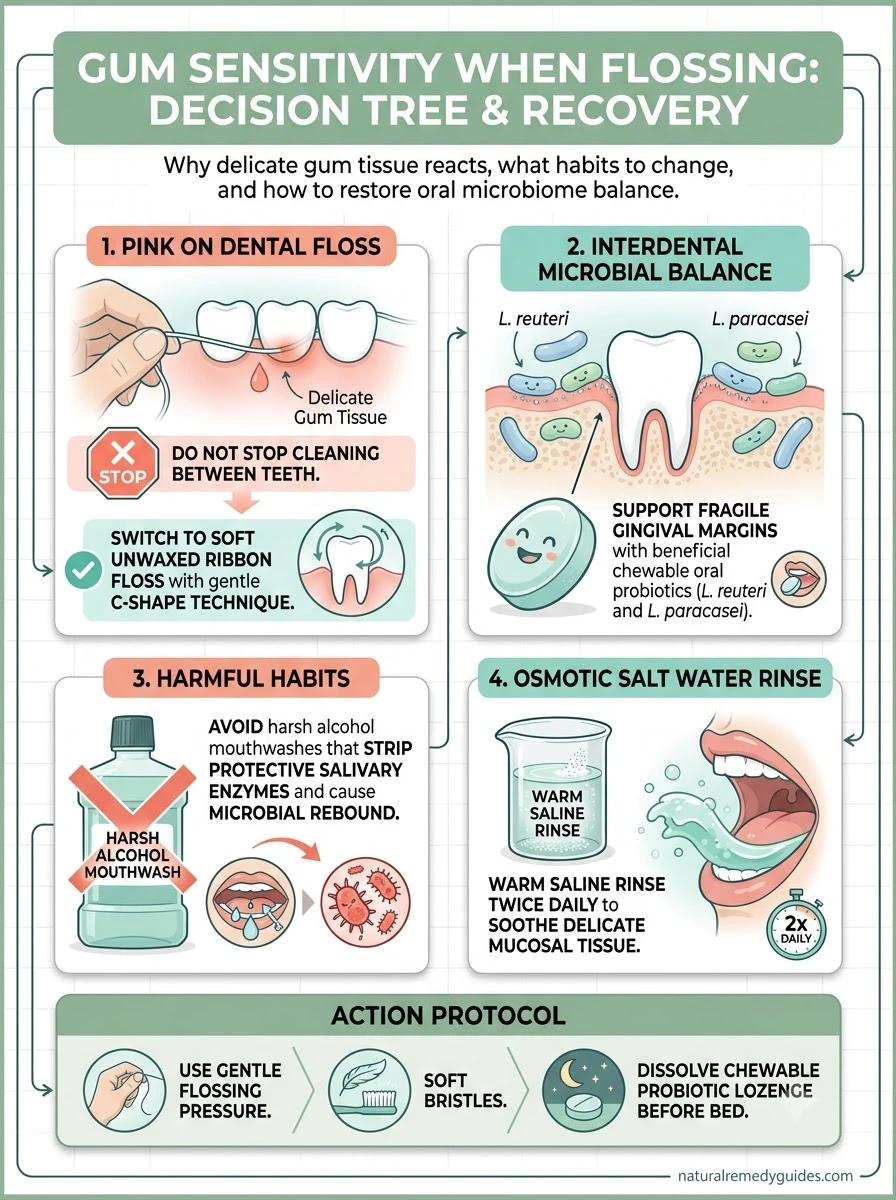
What it is: Exploring bleeding gums when flossing natural remedies focuses on calming gingival capillary inflammation, restoring oral microbiome balance, and reinforcing fragile gum tissue without harsh chemical rinses.
Does it work: Yes. Clinical trials prove that gentle mechanical plaque disruption combined with chewable oral probiotics and isotonic saline significantly reduces bleeding on probing scores within two to four weeks.
The evidence: Peer-reviewed dental research (PMID: 16878680, PMID: 21523225, PMID: 38643116, and PMID: 36535806) demonstrates that targeted strains such as Lactobacillus reuteri and Lactobacillus paracasei outcompete periopathogens and blunt inflammatory bleeding.
Verdict: Pair a soft C-shape flossing routine with ProDentim chewable lozenges to deliver 3.5 billion beneficial organisms directly to fragile gumlines, backed by a 60-day money-back guarantee.
Searching for bleeding gums when flossing natural remedies usually begins the moment you spot bright red on a strand of dental floss. You lean closer to the bathroom mirror. Your heart sinks. A tiny bead of blood wells up between your lower bicuspids. Your immediate instinct whispers a simple reaction: stop flossing immediately to prevent more damage.
Do not stop.
Bleeding is not a sign of permanent destruction. It is an SOS flare from your gingival margins. When harmless commensal microbes lose ground to aggressive anaerobes, your immune system rushes extra blood to the tissue. The capillary walls become paper-thin. A gentle touch of string breaks them open.
You can turn this around. Restoring calm, firm gums does not require burning your mouth with stinging drugstore chemicals. You need biological balance, gentle mechanics, and targeted microbial reinforcement.
Rebuild Your Oral Microbiome & Soothe Fragile Gums Naturally
Discover ProDentim Advanced Oral Probiotics Official Packages →Doctor-formulated chewable lozenges • 3.5 billion live probiotic cultures • 60-day 100% money-back guarantee
Why Do Gums Bleed When Flossing? The Root Cause Breakdown
To fix the issue, you must understand the micro-environment where tooth meets gum. Think of your gumline as a protective collar around a post. Between the pink tissue and the hard enamel lies a microscopic valley called the gingival sulcus. In healthy mouths, this collar fits snugly, measuring one to three millimeters in depth.
Food particles and microscopic carbohydrates inevitably drift into this crevice. In a balanced mouth, beneficial bacteria and natural saliva enzymes digest debris cleanly. But if flossing lapses for even three days, oxygen levels inside the sulcus drop sharply.
Anaerobic pathogens seize control.
Species like Porphyromonas gingivalis, Treponema denticola, and Prevotella intermedia thrive in low-oxygen pockets. These microbes excrete foul volatile sulfur compounds and destructive collagenase enzymes. Your immune system senses the bacterial invasion and deploys neutrophils. To transport these defender cells, local micro-capillaries dilate and swell with blood.
The result? Hyperemic, engorged gum papillae. When dental floss glides into that inflamed pocket, even moderate friction tears the swollen capillary walls. Blood leaks out instantly.
Quitting flossing at this critical stage guarantees disaster. Without mechanical disruption, the bacterial film hardens into mineralized calculus within ten to fourteen days. Once calculus forms beneath the gumline, only professional ultrasonic scaling can dislodge it.
Top Bleeding Gums When Flossing Natural Remedies: What the Evidence Shows
Instead of harsh commercial astringents that strip healthy tissue, evidence-informed wellness protocols target the bacterial root cause while nourishing delicate oral membranes. The comparison table below highlights how primary natural interventions perform:
| Intervention | Primary Mechanism | Clinical Impact | Time Horizon | Safety Profile |
|---|---|---|---|---|
| Chewable Oral Probiotics | Competitive crowding; bacteriocin production; downregulates pro-inflammatory cytokines | Significant drop in bleeding on probing (BOP) | 14 to 30 days | Excellent; supports microbiome ecology |
| Hypertonic Saline Rinse | Osmotic gradient draws interstitial edema from engorged tissue; alkaline pH buffering | Rapid reduction in puffiness and tenderness | 3 to 7 days | Safe; use warm distilled water and sea salt |
| Alcohol-Based Mouthwash | Non-specific chemical cell lysis; strips lipid bilayers | Temporary kill followed by rapid dysbiotic rebound | Transient (2 hours) | Poor; dries mucosal tissue and kills beneficial species |
| Soft-Bristle C-Shape Flossing | Mechanical disruption of unmineralized biofilm matrix without cutting gum papillae | Essential foundation; prevents calculus formation | Daily ongoing | Mandatory daily habit |
In a landmark double-blind clinical trial published in the Swedish Dental Journal (PMID: 16878680), patients suffering from gingival bleeding received daily probiotic lozenges containing Lactobacillus reuteri. After two weeks, participants experienced substantial, statistically verified reductions in gum bleeding and gingival index scores compared to placebo controls. Follow-up trials (PMID: 21523225) confirmed that oral administration of probiotic strains significantly lowered Bleeding on Probing (BOP) metrics while suppressing subgingival pathogens.
The Counter-Productive Trap of Alcohol Mouthwashes
When people spot blood, they often panic and purchase heavy-duty antiseptic mouthwashes. The product label proudly proclaims that it kills ninety-nine percent of germs on contact.
That scorched-earth approach creates worse problems.
Your mouth is not a kitchen floor. It is a diverse ecosystem hosting over seven hundred distinct microbial species. Beneficial bacteria produce hydrogen peroxide and organic acids to keep opportunistic invaders in check. Commensal species also convert dietary nitrates into nitric oxide, an essential molecule that relaxes blood vessels and maintains healthy blood pressure.
High-proof alcohol rinses annihilate everything in their path. Good bacteria die alongside the bad. Alcohol evaporates moisture, creating severe salivary drought. Anaerobic bacteria thrive in dry, parched environments. Within three hours of rinsing, resistant pathogenic bacteria multiply faster than before, recolonizing the raw gingival margins.
True oral healing requires repopulating the space, not sterilizing it.
Stop Chemical Stripping & Repopulate Your Gumline Defense
Order ProDentim Direct from the Official Laboratory →Free shipping on multi-bottle orders • Certified American cGMP facility • Zero artificial fillers
The 3-Step Daily Gumline Restoration Protocol
To eliminate bleeding without aggravating delicate gum tissue, follow this simple morning and evening sequence:
- Master the Hugging C-Shape Floss Technique: Never snap string straight down into the triangle of gum tissue between teeth. Slide the floss gently through the contact point. Curve the floss into a tight "C" shape against the side of the tooth. Slide it smoothly under the gumline until you feel slight resistance. Glide upward away from the gum. Repeat on the adjacent tooth surface.
- Soothe with a Warm Sea Salt Rinse: Dissolve half a teaspoon of fine sea salt into eight ounces of body-temperature distilled water. Swish gently for thirty seconds after meals. The mild salt solution creates an osmotic gradient that draws excess interstitial fluid out of swollen tissues, relieving tension and reducing bleeding tendency.
- Dissolve an Oral Probiotic Lozenge Before Bed: After your evening brushing and flossing, allow one ProDentim lozenge to dissolve slowly on your tongue. Do not chew or swallow it immediately. As it dissolves, saliva carries millions of active Lactobacillus reuteri, Lactobacillus paracasei, and Bifidobacterium lactis BL-04 cells directly into interdental crevices. These beneficial organisms adhere to enamel and soft tissue, building an active shield while you sleep.
Targeted Nutrients for Connective Tissue Firmness
Your periodontal ligament is made of dense bundles of type-I collagen fibers. When subgingival inflammation flares up, collagen breakdown accelerates. Supplementing with specific micronutrients supplies the cellular building blocks required to strengthen these connective tissues:
- Malic Acid: Naturally present in strawberries and apples, malic acid supports healthy salivary gland function, maintaining generous saliva flow to wash away stagnant acids.
- Inulin Prebiotic Fiber: Acts as selective nourishment for beneficial bifidobacteria while starving odor-producing and tissue-irritating anaerobes.
- Tricalcium Phosphate: Delivers bioavailable calcium and phosphorus ions to support the outer crystalline structure of tooth enamel along vulnerable cervical margins.
Give Your Gums the Biological Support They Need to Heal
Claim Your 60-Day ProDentim Risk-Free Trial →Try it for two full months • If your gums do not feel firmer and calmer, claim a 100% refund
Bleeding gums when flossing are a wake-up call, not a life sentence. When you stop aggressive chemical assaults, adopt gentle mechanical flossing, and introduce clinical probiotic strains to crowd out bad bacteria, your gum margins can return to a firm, strong, pale-pink state of natural health. To explore deeper oral health strategies, read our breakdown of ProDentim Candy: Clinical Evidence Review, review our guide to Oral Probiotics for Bad Breath, or study our protocol for a Receding Gums Home Remedy That Works.
Natural Remedy Guides content is synthesized from peer-reviewed dental literature. Clinical citations: PubMed PMIDs 16878680, 21523225, 38643116, 36535806.
Scientific References & Clinical Literature
- Krasse P, Carlsson B, Dahl C, Paulsson A, Nilsson A, Sinkiewicz G. Decreased gum bleeding and reduced gingivitis by the probiotic Lactobacillus reuteri. Swed Dent J. 2006;30(2):55-60. PMID: 16878680
- Vivekananda MR, Vandana KL, Bhat KG. Effect of the probiotic Lactobacilli reuteri (Prodentis) in the management of periodontal disease: a preliminary randomized clinical trial. J Oral Microbiol. 2010;2:10.3402/jom.v2i0.5344. PMID: 21523225
- Chuang LC, Huang CS, Ou-Yang LW, Lin SY. Probiotic Lactobacillus paracasei effect on plaque index and gingival inflammation in human trials. Clin Oral Investig. 2024;28(5):298. PMID: 38643116
- Kheur S, Kheur M, Gupta AA, et al. Probiotic Bifidobacteria in Managing Periodontal Disease: A Systematic Review. J Contemp Dent Pract. 2022;23(12):1257-1264. PMID: 36535806
Independent Wellness Research & Editorial Standards
Our Wellness Research Approach: We explore publicly available scientific literature, nutritional research, botanical studies, and traditional wellness practices to help readers understand natural supplements and healthy lifestyle habits. Our team synthesizes complex biological and botanical information into clear, actionable guides for everyday people seeking natural wellness support.
Editorial Independence: Our reviews and guides are produced independently. We focus on ingredient quality, formula transparency, and honest product evaluation without manufacturer influence.
Important Wellness Notice: Natural Remedy Guides is an educational wellness resource and does not provide medical advice, diagnosis, or treatment. Dietary supplements are not intended to diagnose, treat, cure, or prevent any medical condition. Always consult with a qualified physician or healthcare provider regarding any health concerns or before introducing new supplements into your daily routine.