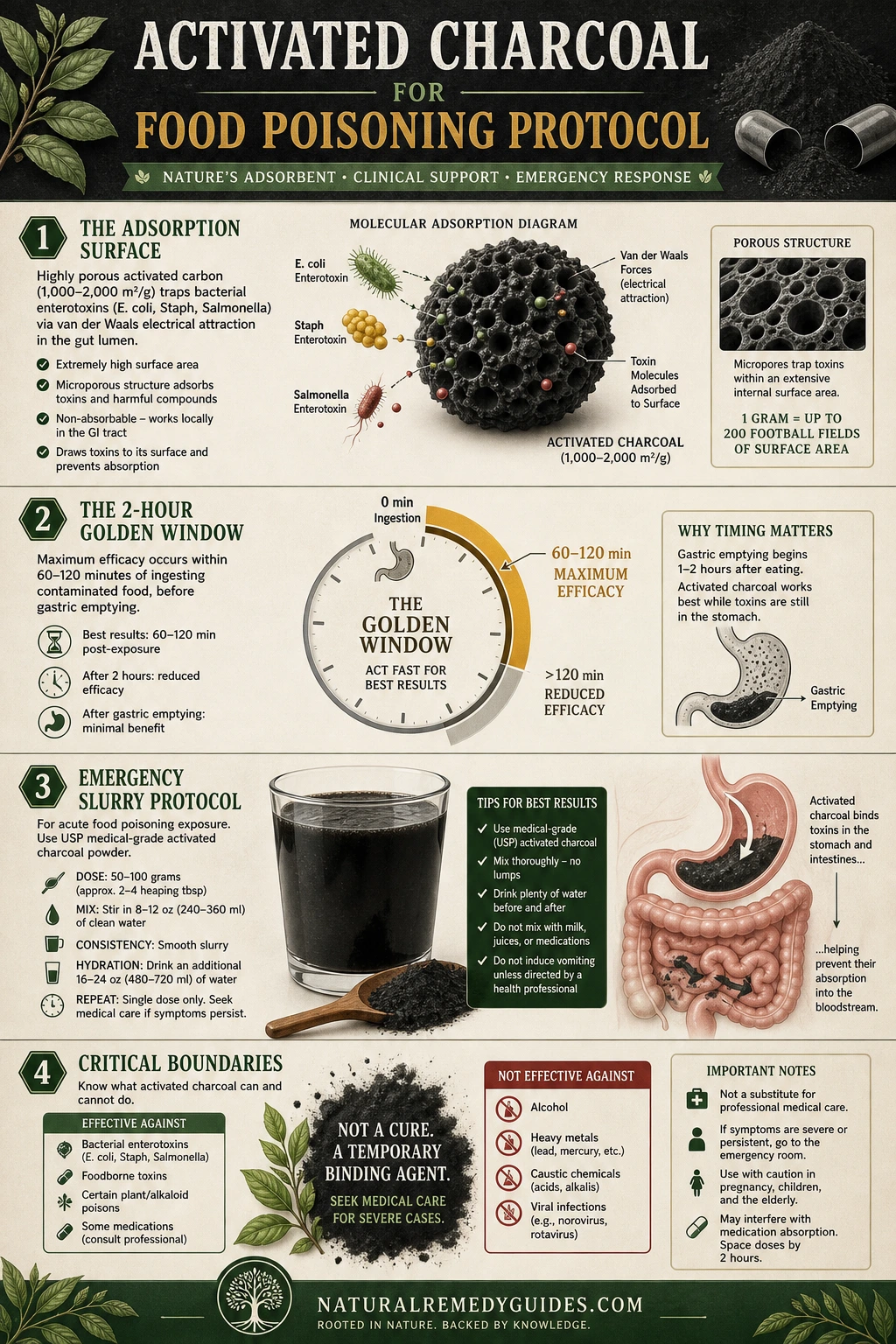
The Bottom Line: Pure activated charcoal acts as an inert trap. It binds bacterial poisons in gut fluids before your body absorbs them into circulation.
Who It Is Best For: Households preparing for food emergencies, travelers, and anyone feeling sick within two hours of eating questionable food.
The Reality Check: Activated charcoal is not an all-purpose cure. It binds bacterial poisons, yet fails against viral flu bugs, alcohol, and caustic chemicals. Act early.
Using activated charcoal for food poisoning requires understanding a strict biological race against time. It usually begins two hours after dinner. Your belly knots up. A cold sweat breaks out. Nausea hits in waves. You realize that lukewarm seafood salad or unrefrigerated deli meat had spoiled.
Panic sets in fast. You need help. You reach for black charcoal capsules.
Can fine black powder really halt a food crisis? Yes, but only if you use it correctly. Most people take the wrong dose at the wrong hour. When used with discipline, pure carbon binds bacterial poisons before they enter your blood. When used incorrectly, it simply leaves a gritty mess. Here is how to handle a food poisoning emergency with practical home care.
Master Practical Medicine & Off-Grid Emergency Care
Get The Home Doctor Emergency Handbook →Doctor-written household triage handbook • 60-day 100% money-back guarantee
How Activated Charcoal for Food Poisoning Works in the Gut
People often mix up absorption and adsorption. They sound the same. In science, they work in opposite ways.
Absorption works like a sponge soaking up water. Liquid draws deep inside. In contrast, adsorption is an electrical surface lock. It binds loose particles tightly to an outer surface through natural electrical attraction.
Activated carbon is pure wood or coconut shell treated with high heat and steam. This heat hollows out millions of microscopic pores across every tiny grain. The resulting surface area is vast. In fact, a single gram of medicinal activated charcoal holds an internal surface area between one thousand and two thousand square meters, which equals the total floor space of four full basketball courts packed into a single teaspoon of fine powder. When contaminated food enters your warm stomach, dangerous bacteria like Staphylococcus and Salmonella release potent toxins that irritate nerve endings, trigger violent abdominal contractions, and draw gallons of fluid directly into your lower digestive tract. As the black fluid moves through your stomach, it acts as a magnetic web. It traps free bacterial poisons across its maze of pores.
Once trapped inside the microscopic maze of carbon fissures, free bacterial poisons cannot cross into your bloodstream, allowing your digestive tract to eliminate the harmless bound particles through normal bowel movements. Your organs stay safe. You avoid systemic sickness. Relief follows.
The 2-Hour Golden Window: Why Timing Matters
Speed determines whether activated charcoal food poisoning protocols succeed or fail. Bacterial poisons do not wait in your stomach.
When you swallow spoiled potato salad, bacteria dump toxins straight into food. Once that meal leaves your stomach, poisons enter your intestines. From there, your gut absorbs them into your blood within hours. You get sick.
Hospital toxicology research confirms that taking activated charcoal within sixty minutes of ingesting contaminated food blocks almost half of the free bacterial toxins from crossing the sensitive epithelial barrier of your digestive tract (PMID: 15822758):
- Taken within 30 minutes: It binds up to 47% of ingestible poisons and protects your gut.
- Taken at 60 minutes: Binding falls to roughly 40%, yet still catches heavy bacterial loads.
- Taken at 120 minutes: Binding drops below 16% as your stomach empties food into the gut.
- Taken after 4 hours: It offers very little benefit for stomach poisons, though it may calm lower bowel gas.
The lesson is simple. Do not wait for vomiting or loose stools to peak before acting. If you know you ate spoiled food and early stomach cramps begin, the time to act is right away. Every minute counts. Drink it down.
Activated Charcoal Dosage for Food Poisoning & Slurry Preparation
The most common mistake at home is taking two small 250-milligram capsules from a grocery shelf. That tiny dose gives you half a gram of carbon. In a sudden foodborne crisis, half a gram is like throwing a single paper napkin at a burst water pipe. It is not enough. You need mass.
Real emergency protocols need substantial mass. You need a ten-to-one charcoal-to-toxin ratio.
| Patient Category | Standard Emergency Dose | Liquid Suspension Volume | Delivery Method |
|---|---|---|---|
| Adult (Acute Exposure) | 50 g to 100 g USP powder (1 g/kg body weight) | 300 mL to 500 mL clean water | Drink complete slurry rapidly within 10 minutes |
| Child (1 to 12 Years) | 25 g to 50 g USP powder (0.5 to 1 g/kg) | 150 mL to 250 mL clean water | Sip slowly in small cups to prevent gag reflex |
| Secondary Dosing (Gas & Cramps) | 12.5 g to 25 g every 4 to 6 hours | 250 mL water per dose | Optional maintenance for lingering colonic cramps |
How to Take Activated Charcoal for Food Poisoning Safely
Follow these practical home steps:
- Pick Pure USP Grade: Use food-grade or medicinal powder made from virgin coconut shells. Never touch barbecue charcoal. It contains toxic fuel binders.
- Mix with Plain Water: Spoon your dose into a wide shaker cup. Add clean lukewarm water. Shake it well until the powder forms a smooth black drink.
- Skip Milk and Juice: Never mix charcoal with dairy milk or sweet smoothies. Fats and milk proteins clog the fine pores, filling up the charcoal before it touches bacterial poisons.
- Drink with a Straw: Activated charcoal has no flavor, yet it feels gritty. Drinking with a wide straw skips your front teeth, preventing dark mouth stains.
Food Poisoning vs. Stomach Bug: What Charcoal Can and Cannot Bind
Many people search for activated charcoal for stomach bug relief. Here, knowing the biology is essential.
Food poisoning comes from eating bacteria or bacterial toxins sitting on spoiled food. Common examples include Salmonella, Escherichia coli, and staphylococcal toxins. Published laboratory trials confirm that activated charcoal particles strongly adsorb *E. coli* cells and neutralize free enterotoxins in gut fluids (PMID: 11307928, PMID: 30023235).
Because viral gastroenteritis reproduces deep inside the mucosal cells of your small intestine rather than floating loosely in your stomach cavity, activated charcoal remains powerless to stop active norovirus or rotavirus replication. It cannot kill viruses.
If several members of your family develop sudden nausea and fever days after visiting a school or crowded event, you are almost certainly facing a contagious viral stomach bug rather than foodborne bacterial contamination. Using activated charcoal for stomach virus will not cure that illness. It may soak up extra gas, but it will not kill the bug. You must focus on fluids. Rest is vital.
| Substance / Target | Adsorbed by Charcoal? | Biological Mechanism & Reason |
|---|---|---|
| Bacterial Enterotoxins (Staph, E. coli) | YES (High Affinity) | Binds large organic toxin proteins in micropores via electrostatic charge |
| Plant Alkaloids & Fungal Poisons | YES (High Affinity) | Hydrophobic molecules adhere tightly to carbon lattice planes |
| Viral Pathogens (Norovirus, Rotavirus) | NO (Zero Binding) | Viruses replicate inside cellular tissue; charcoal stays within the gut lumen |
| Alcohol & Solvents (Ethanol, Methanol) | NO (Zero Binding) | Small polar molecules lack chemical affinity for nonpolar carbon pores |
| Heavy Metals (Iron, Lithium, Lead) | NO (Zero Binding) | Inorganic ions require chemical chelation rather than physical carbon adsorption |
| Corrosive Acids & Alkalis (Bleach, Lye) | NO (Strictly Forbidden) | Causes severe throat burning and masks visual damage during endoscopy |
Managing Dehydration & Electrolyte Loss During Food Poisoning
While activated charcoal for diarrhea helps firm up loose bowel movements, diarrhea is not your main threat. Dehydration is. Loss of fluid kills.
When bacterial poisons irritate your gut, intestinal cells dump large amounts of water and salts into your bowels. If you lose more fluid than you drink, your blood pressure drops, your kidneys work too hard, and you feel weak.
Every dose of charcoal requires plenty of water. Charcoal pulls moisture from your digestive tract. If you swallow dry charcoal without water, it can form a hard lump in your bowel. Always drink a tall glass of water with every dose. Stay hydrated. Do not skimp on fluids.
Drinking an oral electrolyte solution containing six teaspoons of pure sugar and half a teaspoon of salt per liter of water activates sodium-glucose cotransporters in your intestinal lining, driving hydration directly into your bloodstream. This simple mix helps your gut pull water straight into your blood. It keeps your energy steady while your body clears the sickness. Sip it slowly.
Red Flag Warning Signs: When to Seek Immediate Medical Help
Home remedies provide valuable help when traveling, camping, or waiting for care. However, you must know when a case needs hospital attention:
- You cannot keep fluids down for twelve hours.
- You see dark blood in your vomit or stool.
- Your fever climbs above 102 degrees Fahrenheit.
- Sharp pain settles in the lower right side of your belly.
- You notice blurred vision or muscle weakness.
Be Ready When Doctors & Pharmacies Are Offline
Get The Home Doctor Emergency Handbook →Comprehensive emergency medical manual • Step-by-step home triage • 60-day guarantee
Frequently Asked Questions
Does activated charcoal cure food poisoning?
No. Charcoal does not kill live germs or heal swollen gut tissue. It works like a fine sponge. The porous grains trap free bacterial poisons in your stomach before they enter your blood. This stops sickness from spreading.
What is the best activated charcoal dosage for food poisoning?
Clinical guidelines suggest a single adult dose of 50 to 100 grams of pure USP charcoal powder stirred into water. That equals about one gram per kilogram of body weight. For children, the common dose is 25 to 50 grams mixed in a cup of water.
Does activated charcoal work for a stomach bug or stomach virus?
No. A stomach bug from norovirus or rotavirus grows deep inside your gut wall cells. Activated charcoal stays in your digestive tract. It cannot reach inside human cells. It will not cure a viral bug.
How long after eating bad food can you take activated charcoal?
Take it within one to two hours of your meal. That is the golden window. Once spoiled food leaves your stomach and enters your small bowel, charcoal loses most of its power. Early action is key.
What should you not take with activated charcoal?
Do not take charcoal with daily prescription drugs, heart pills, or birth control. Charcoal binds medications and stops them from working. Wait at least two to three hours before taking regular medicine.
Clinical References & Educational Sources
- Chyka PA, Seger D, Krenzelok EP, Vale JA. Position paper: Single-dose activated charcoal. Clin Toxicol (Phila). 2005;43(2):61-87. PMID: 15822758.
- Naka K, Watarai S, Tana, et al. Adsorption effect of activated charcoal on enterohemorrhagic Escherichia coli. J Vet Med Sci. 2001;63(3):281-285. PMID: 11307928.
- Aniagor CO, Menkiti MC, Umeh CF. Effect of pore size and morphology of activated charcoal prepared from midribs of Elaeis guineensis on adsorption of poisons using metronidazole and Escherichia coli O157:H7 as a case study. Appl Water Sci. 2018;8:185. PMID: 30023235.
- Oluwasola AA, et al. Comparative evaluation of hospital-grade activated charcoal for paracetamol adsorption under simulated gastric and intestinal fluid. Toxicol Rep. 2026;13:101890. PMID: 41994852.
Independent Wellness Research & Editorial Standards
Our Wellness Research Approach: We explore publicly available scientific literature, nutritional research, botanical studies, and traditional wellness practices to help readers understand natural supplements and healthy lifestyle habits. Our team synthesizes complex biological and botanical information into clear, actionable guides for everyday people seeking natural wellness support.
Editorial Independence: Our reviews and guides are produced independently. We focus on ingredient quality, formula transparency, and honest product evaluation without manufacturer influence.
Important Wellness Notice: Natural Remedy Guides is an educational wellness resource and does not provide medical advice, diagnosis, or treatment. Dietary supplements are not intended to diagnose, treat, cure, or prevent any medical condition. Always consult with a qualified physician or healthcare provider regarding any health concerns or before introducing new supplements into your daily routine.