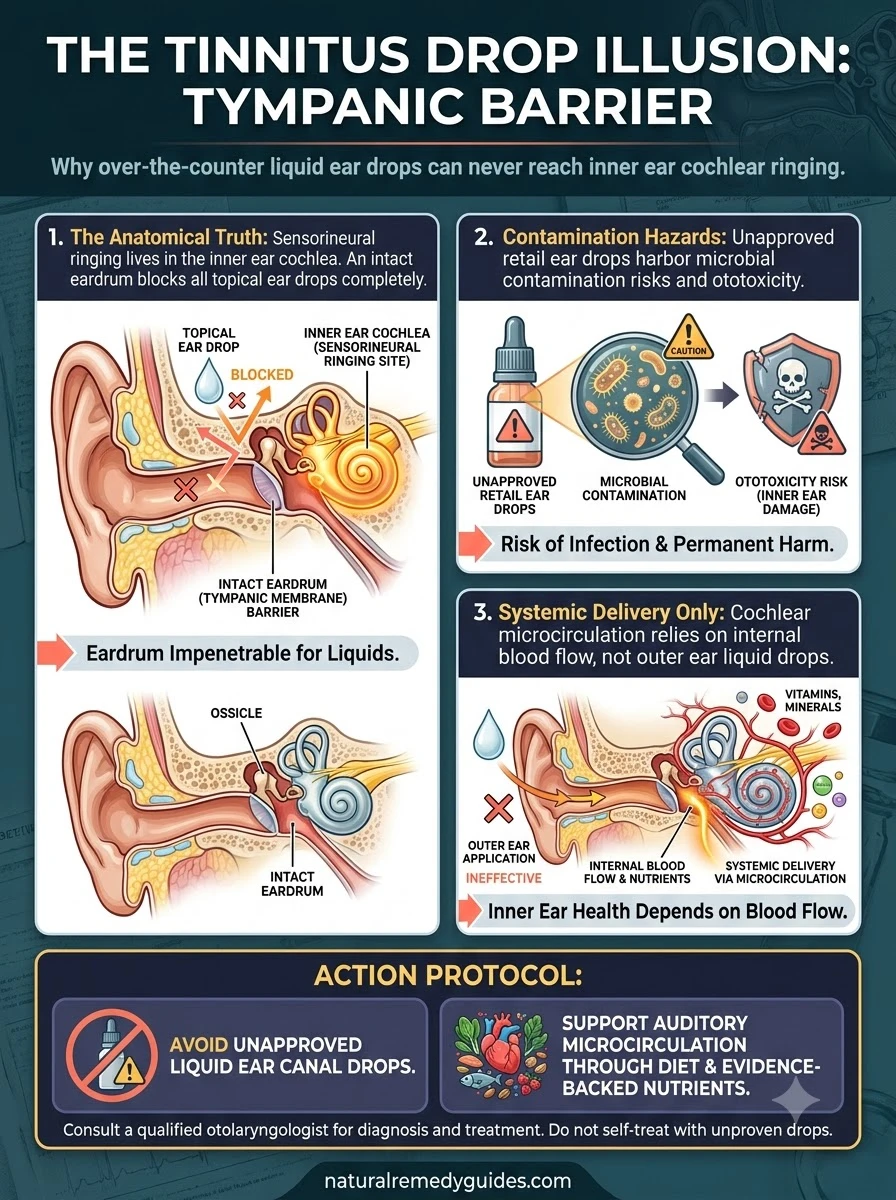
If you tilt your head back and squeeze liquid ear drops into your canal hoping to silence high-pitched ringing, stop right now. You are pouring hard-earned money—and potentially unsterile microbes—down a dead-end anatomical corridor.
Federal health regulators have issued urgent warning letters to manufacturers of retail and online “tinnitus relief” ear drops. Independent laboratory surveillance and otology reviews confirmed that these over-the-counter tinctures violate federal law as unapproved new drugs. Even worse, facility inspections uncovered severe microbiological sterility breaches, exposing unsuspecting buyers to dangerous ear canal infections and chemical irritation (PMID: 32442436).
The products promise fast relief from buzzing, roaring, and clicking sounds. Yet clinical data tells a completely different story. Zero absorption. Pure marketing fiction.
When an unsuspecting consumer drops twenty dollars on an over-the-counter tincture promising instant relief, they are falling victim to clever packaging that completely ignores centuries of established otolaryngological science.
The FDA warns consumers that there are no FDA-approved over-the-counter ear drops to treat tinnitus. Using unsterile liquids in the ear canal introduces serious infection risks. In addition, if you have a weakened or perforated eardrum, unapproved chemical tinctures can leak directly into the middle ear space, triggering acute dizziness, hearing loss, and permanent chemical ototoxicity.
The Tympanic Wall: Why Ear Drops Cannot Reach Your Ringing
How did drugstore ear drops become a multi-million-dollar consumer trap?
The answer begins with a basic misunderstanding of human anatomy. When you experience chronic ear ringing, where is the noise coming from? Most people assume the problem lives in their outer ear canal. It feels like a bug trapped near your eardrum.
In truth, sensorineural tinnitus originates deep inside your inner ear—in the snail-shaped organ known as the cochlea (PMID: 29985474).
Thousands of microscopic hair cells line your inner cochlear chambers. These delicate structures act like fragile antennae. When age, loud sound exposure, or restricted microcapillary blood flow starve these hair cells of oxygen, they misfire erratic electrical bursts. Your brain interprets those misfires as phantom high-pitched screeching.
Here lies the insurmountable biological barrier.
Your eardrum—the tympanic membrane—is a thick, three-layered biological shield designed specifically to keep external liquids, dirt, and bacteria out of your auditory apparatus. Intact eardrums are completely waterproof. When you squeeze drops into your ear canal, the liquid pools against the outer face of that leathery membrane. Not a single molecule crosses into your middle ear, let alone your deep cochlear chambers.
Topical ear drops can treat swimmer’s ear in the outer skin. They cannot touch your cochlea. It is anatomically impossible.
Worse, placing unsterile herbal tinctures into the ear canal often triggers severe allergic contact dermatitis or bacterial overgrowth. And if an undiagnosed microscopic tear exists in your eardrum, harsh chemical drops leak into the middle ear cavity, poisoning delicate auditory ossicles (PMID: 14763328).
Because the auditory nerve pathways receive their nutrient supply exclusively through microvascular perfusion from the labyrinthine artery, real therapeutic support requires delivering standardized bioflavonoids and neuro-protective minerals directly through the bloodstream rather than pouring topical solutions into an empty outer canal.
How to Support Auditory Nerve Pathways Safely
If external ear drops are useless for sensorineural ringing, how can you nourish damaged auditory hair cells?
The only biological doorway into your cochlea runs through systemic blood vessels. The auditory artery supplying your inner ear is narrower than a strand of sewing thread. Feeding those microscopic capillaries requires systemic botanical compounds and nerve antioxidants that travel through your bloodstream:
- 1. Discard Unapproved Ear Drops: Immediately throw away OTC tinctures claiming to cure tinnitus through the outer ear.
- 2. Never Insert Foreign Objects: Cotton swabs and unsterile dropper tips pack earwax against the eardrum and risk tympanic puncture.
- 3. Enhance Cochlear Microcirculation: Standardized extracts of Hawthorn Berry and Ginkgo Biloba dilate constricted microcapillaries, delivering fresh oxygen to struggling auditory hair cells (PMID: 15303276).
- 4. Shield Auditory Nerve Myelin: Supply daily bioavailable Zinc, Vitamin B12, and antioxidants to calm erratic neural signaling and protect delicate auditory pathways against oxidative wear.
Natural Remedy Guides continues tracking federal otology warnings, cGMP laboratory audits, and retail supplement enforcement.