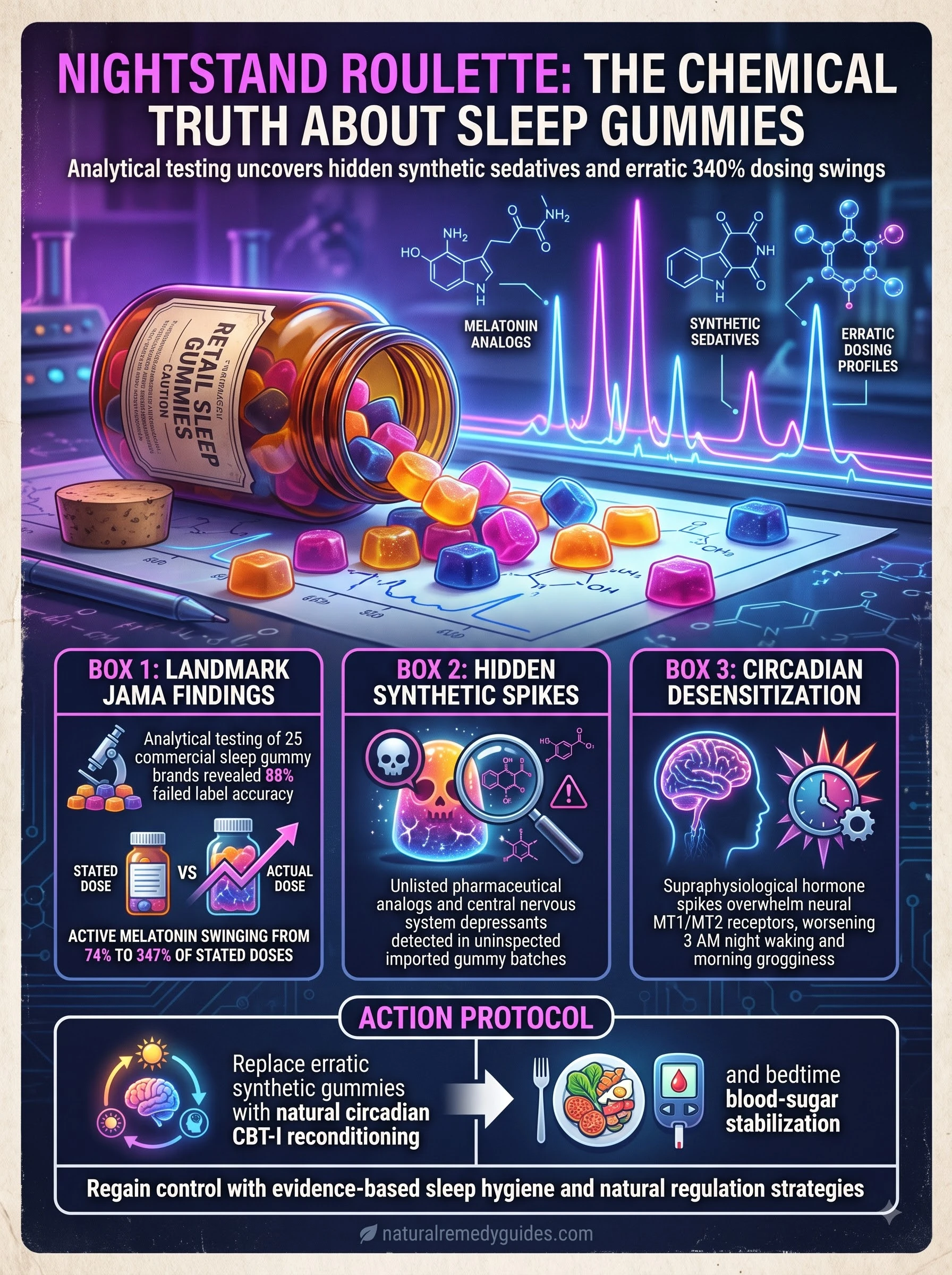
If you pop two fruit-flavored sleep gummies before climbing into bed each night, examine that colorful bottle on your nightstand immediately. What looks like harmless candy from your local pharmacy shelf may actually contain dangerous drug-level spikes and hidden synthetic depressants.
Federal health regulators and university toxicology teams have issued an urgent nationwide consumer warning. Independent high-performance liquid chromatography and mass-spectrometry testing across retail sleep gummies revealed alarming rates of chemical adulteration, severe active ingredient mislabeling, and contamination with unapproved pharmaceutical analogs.
In a landmark analysis published in the Journal of the American Medical Association (JAMA), analytical chemists evaluated 25 prominent commercial brands of over-the-counter sleep gummies. The laboratory results were staggering. Nearly 88% of tested products failed to match their printed label claims, with actual melatonin concentrations swinging wildly between 74% and 347% of the advertised dose (PMID: 37097362).
One single gummy yielded more than three times the stated potency. That means an unsuspecting consumer taking two bedtime chews could easily ingest upwards of 30 milligrams of synthetic hormone in one gulp—a massive supraphysiological surge that overwhelms neural receptors.
Ingesting inaccurately compounded sleep chews carries severe clinical hazards. Wildly erratic melatonin overdoses trigger profound receptor desensitization, morning cognitive impairment, and severe cardiovascular stress. Even worse, screening uncovered undeclared synthetic central nervous system depressants added to mimic immediate sedation, creating lethal interaction risks for individuals taking prescription cardiac, antidepressant, or sedative medications.
The Factory Floor Shortcut Behind Chewy Supplements
How does a $12 bottle of drugstore sleep gummies end up with 347% more active hormone than the label states?
The culprit is poor manufacturing discipline. Gummy candy formulas are notoriously unstable vehicles for precise nutritional compounding. Liquid gelatin and corn-syrup slurry must be heated to high temperatures during industrial molding. Because active botanical compounds and melatonin degrade rapidly when exposed to cooking heat, contract packagers frequently practice what the industry quietly calls “overage dumping.”
Factories dump massive excess quantities of synthetic active powders into industrial mixing vats, hoping that enough survives the boiling kettles to meet minimum label guarantees. But gelatin slurries cool unevenly inside rubber conveyor molds. Active powders settle to the bottom of the vats. The resulting production batches vary wildly—one gummy in the bottle contains almost zero active hormone, while the gummy next to it delivers a toxic megadose.
Worse, predatory manufacturers facing competitive pressure to deliver instant “knockout” results secretly spike their mixes with undeclared first-generation antihistamines, synthetic cannabinoid analogs, and unapproved sedatives. These rogue chemicals trick buyers into thinking the gentle herbs are performing miracles. In truth, users are ingesting unmonitored pharmaceutical depressants.
The Midnight Ambush: Why Gummy Sedatives Trigger 3 AM Panic
This regulatory alert exposes the fundamental biological flaw in relying on chewable sedatives for chronic insomnia.
A sudden flood of 10 to 30 milligrams of synthetic melatonin knocks your conscious brain out cold at 10:30 PM. But human melatonin receptors were never designed to handle industrial floods. Your pineal gland naturally produces a tiny trickle measured in micrograms—roughly 0.1 to 0.3 milligrams per night.
Supraphysiological spikes crush your natural circadian feedback loops. As the synthetic wave washes out of your neural synapses around 2:30 AM, your brain experiences a sharp neurochemical crash. This sudden rebound coincides with dropping nocturnal blood glucose.
When your liver runs low on stored glycogen overnight, your adrenals dump emergency adrenaline and cortisol to mobilize fuel (PMID: 17400929). Instead of sleeping through until dawn, you jolt awake at 3:14 AM. Your heart pounds. Your palms feel cold and clammy. Your thoughts race in panic while the remaining synthetic compounds leave you feeling dizzy, hungover, and completely exhausted.
Drugstore chews do not fix sleep. They shatter sleep architecture.
4 Rules to Safeguard Your Nighttime Routine
To protect your brain from tainted retail batches and rebuild deep restorative sleep naturally:
- 1. Audit Your Supplement Cabinet: Check the brand and batch codes on any chewable sleep aid or relaxation formula. Discard unverified products, imported private-label chews, and any product promising guaranteed knockout sedation.
- 2. Never Rely on Mega-Dose Melatonin: Massive hormone doses (5mg to 10mg+) desensitize MT1 and MT2 brain receptors and guarantee midnight awakenings. Your body needs circadian entrainment, not chemical sedation.
- 3. Stabilize Bedtime Liver Glycogen: Prevent the 3 AM adrenaline surge by providing steady nocturnal fuel. A light snack containing raw nut butter or complex fats thirty minutes before bed keeps liver glucose steady through sunrise.
- 4. Retrain Sleep Conditioning with Clinical CBT-I: Real sleep recovery happens through behavioral architecture. Clinical trials confirm that cognitive behavioral retraining cuts nighttime wakefulness by 26 minutes without pills, dependency, or morning grogginess (PMID: 26054060).
Natural Remedy Guides continues tracking federal laboratory enforcement actions, cGMP manufacturing inspections, and retail consumer safety advisories.